Unity in Community Picnic: Sunday Sept. 3

N.b. as of 10 a.m., the forecast for 4-6 p.m. TODAY is: PARTLY SUNNY.

We cordially invite you to an end-of-summer Unity in Community Picnic, sponsored by the Sierra Club Sustainability Committee, Don’t Spray Me! and the West Chester Food Co-op–3 groups working together for people and the environment.

This celebration of growth–both in the number of Don’t Spray Me! supporters and in public consciousness of our message–will take place on Sunday, September 3, from 4 to 6 p.m., in Everhart Park, on the Union St. side, between S. Brandywine St. and S. Bradford Ave., West Chester Borough. (Rain date: Labor Day, Monday Sept. 4.)

We are happy to be able to offer free frozen yogurt for kids from Whirled Peace Frozen Yogurt, sponsored by DSM, Sierra Club, Carolyn and Tom Comitta, Margaret and Jim Hudgings, and Thriving Pets. Others are welcome to purchase frozen yogurt from the truck.

Come learn about Bat House-making, get the kids involved in fun environmental games, enjoy sample food from the Food Co-op, experience demonstrations such as Tai Chi and Yoga, see Sierra Club displays, and be in plenty of good company. Please bring your picnic and utensils.

We also commemorate the life of Graham Hudgings, an inspiration to our founding and all of our activities and a long-time sufferer from multiple chemical hypersensitivities, who tragically left us earlier this year.

For more information contact Margaret Hudgings at mhudgings@gmail.com/ or 610-692-3849.

Birmingham and Thornbury get 48-hour warning

[DSM note: This is not what we want to happen. This large residential area on both sides of route 202 in 2 townships contains many dwellings and several bodies of water and streams. Anyone in the area, please try to observe and let us know:

• Are adequate warning posted well in advance so residents and visitors will know to stay out of the way of the spray and take protective measures?
• Did you observe people who were not aware of the recommended precautions?
• Is there a vehicle with a loud speaker in front of the spray truck warning people to stay indoors or leave the vicinity?
• Does the truck spray more than once in any street or on any area?
• Is the spray shut off as the truck approaches a stream or body of water and if so, how many feet away?
• After spraying, what difference do you notice in the number of mosquitoes and other insects such as honey bees and dragonflies?
• Did you notice any effect, either immediate or after a few days, on children, cats, frogs, birds, or bats?
• How long does it take for the adult mosquito population to get back to about what it was before?]

Mosquito control treatment scheduled for Birmingham and Thornbury Townships

News release from Chester County Health Department, 8/8/17, 4:30 p.m.

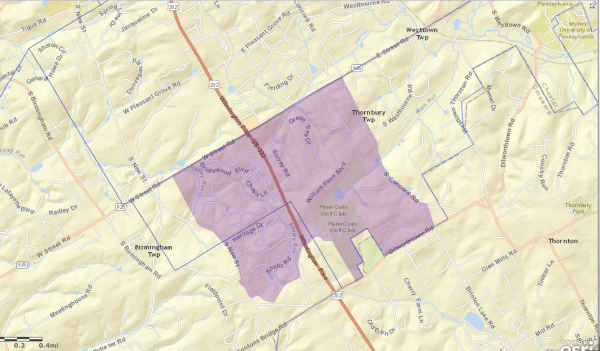
The Chester County Health Department will conduct a mosquito control treatment spray in portions of Birmingham and Thornbury Townships (map of treatment area). The treatment is scheduled for Thursday, August 10th from 7:45 pm to 11:00 pm. The rain date for this event is Tuesday, August 15th from 7:45 pm to 11:00 pm.

The Chester County Health Department conducts mosquito control treatment in areas with high levels of mosquito activity and where multiple mosquito samples have tested positive for West Nile Virus (WNV). After exhausting all other available mosquito control strategies, spraying is conducted to reduce residents’ risk of WNV infection. Anyone living in an area where mosquitoes are infected with WNV is at risk, but the risk of infection is highest for people who work outside or participate in outdoor activities. Less than 1% of people infected will develop serious illness. While serious illness can occur in people of any age, people over 60 years of age, people who have received organ transplants, and people with certain medical conditions such as cancer, diabetes, hypertension, and kidney disease are at the greatest risk for serious illness.

The Chester County Health Department uses a truck-mounted sprayer to apply 1.5 ounces of U.S. Environmental Protection Agency-approved product (Permanone) per acre of land. The mosquito control spray becomes inactive in just a few hours or with sunshine. Sprays are conducted after sunset, when mosquitoes are most active and bees have returned to their hives. Sprayers are turned off near bodies of water and apiaries to protect aquatic life and bees. The Chester County Health Department also notifies registered beekeepers and residents who are listed as hypersensitive in a designated spray area prior to conducting a spray. People who are concerned about exposure to mosquito control products can reduce their potential for exposure by staying indoors with children and pets when their neighborhood is being sprayed. If you would like to take extra precautions after the spray is completed, you can rinse off outdoor furniture or playground equipment before use.

Although spraying helps to reduce mosquito populations, the Chester County Health Department encourages residents to “Make You and Your Home a Bite-Free Zone” to prevent WNV and other mosquito-borne diseases. Because mosquito-borne diseases are spread through the bite of an infected mosquito, residents can reduce their risk by using insect repellent and other personal protection and getting rid of standing water on their property….

read more for general advice at Chester County Health Department

If you are in the purple area on the downloaded map below, the plan is to spray you on Aug. 10 (the same area was sprayed on Sept. 12, 2016):
The importance of larviciding … including out of sight

In the 4-part mosquito life cycle*, the most vulnerable stage is the larva. Eggs are designed to survive, pupae don’t need to eat and their chief enemy would be rough water preventing them from breathing, and adults are elusive fliers and many survive even the most determined application of toxic chemicals.

But larvae depend on feeding on organic matter in unclean standing water. If they get too hot or cold, don’t find enough food, or can’t breathe regularly at the surface of calm water, they will develop into adults either slowly or not at all. Continue reading

Citizen measures for mosquito control become more urgent!

As often happens in mid-summer, mosquito traps set by the County are starting to show some West Nile virus positives. This means that at certain trap sites, over a 24-hour period, one or more mosquitoes out of the scores or hundreds trapped were carrying the virus.

No humans are known to have been affected so far in Chester County, but this means we citizens should redouble our efforts to curb the mosquito population and fend off spraying, whose harmful effects are known and whose benefits, if any, are unproven beyond the initial destruction of adult insects of all species.

Two West Nile Virus positives this month have occurred at Greenfield Park at S. Franklin St.,and Greenview Alley, West Chester, just south of E. Nields St., in West Chester, ward 4, in the southeast part of the Borough

Also, there have been positives in a couple of other sites around the County.

To do your part, please refer to “What can I do to reduce the mosquito population?” and the concrete advice on the Borough site’s Mosquito Awareness page about suppressing standing water.

In West Chester, Block Captains should by now have distributed both 1) a letter from Mayor Jordan Norley and 2) a doorhanger from the Borough.

If you live outside West Chester Borough, please contact us and we will put you in touch with others in your community.

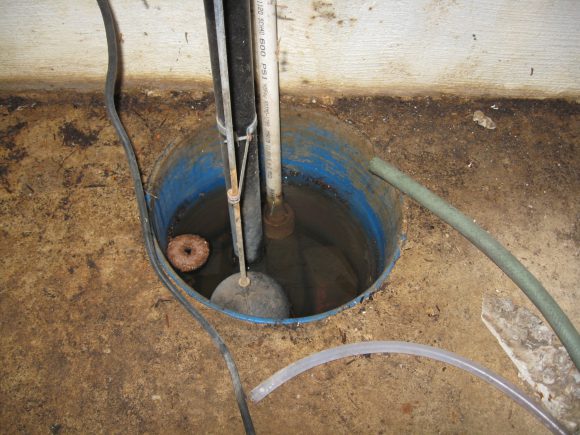
The sump pump danger

Please examine closely:

Potential mosquito breeding ground, right? Nice dirty stagnant water, gathering at the bottom of a bulkhead to be pumped out.

Can mosquitoes fly in? Certainly; no bulkhead is constructed tight enough to keep out a small insect.

Has the homeowner taken the right precautions?

Yes! Note the Bti larvicide tablet floating on the left side. Very good!

The mosquitoes are coming… to East Bradford!

Thanks to the East Bradford municipal administration for giving their residents useful guidelines for protection against breeding and being bitten by mosquitoes. The article below is from page 6 of the East Bradford summer 2017 newsletter.

In addition, East Bradford’s Environmental Advisory Council (EAC) has prepared further information which you can download at the EAC site, including a very thorough In-Depth Report and a Summary.

DSM wishes East Bradford residents as mosquito-free summer as possible!

s

Film & environment

Opportunity for film buffs:

Don’t Spray Me and Sierra Club Sustainability Committee are working with West Chester University to create an environmental film series to be rolled out this fall.

If you are interested in film and would like to join the group, please contact Margaret Hudgings, mhudgings@gmail.com.

Tire piles: mosquitoes’ favorite breeding ground

If you spot a pile of tires exposed to precipitation, please let us know. Tires, whether old or new, are mosquitoes’ best breeding territory, because they warm up in the sun and hold water long-term invisible to human eyes. N.b. in West Chester, tires should be stored inside, not  outside.

Excerpt from “What Tire Pile Owners Should Know About West Nile Virus” download at PA DEP:

Could a tire pile be a mosquito-breeding site?

Tire piles could provide suitable areas for mosquitoes to live, including those known to carry WNV. When discarded tires are allowed to accumulate even a small amount of water, they become attractive sites for mosquitoes to lay their eggs. For example, during the course of one season, thousands of mosquitoes can emerge from just one tire. If tires infested with mosquito eggs, larvae or pupae are transported, the potential to spread mosquito populations increases. This is one of the theories on how WNV was introduced into the United States.

How can a property owner prevent mosquito breeding?

It is the responsibility of the tire pile owners to make sure that the pile does not create a nuisance or health hazard. There are a number of ways to eliminate mosquito production in tire piles.

Standing water in the tires should be eliminated. This can be accomplished by properly storing tires under a tarp or other cover, removing the side wall, or drilling holes in the back of the tire.

In situations where eliminating mosquito production areas is not a practical alternative, larviciding is the most effective control technique….

read the full download here: Tire piles 3800-FS-DEP2535