The importance of larviciding … including out of sight

In the 4-part mosquito life cycle*, the most vulnerable stage is the larva. Eggs are designed to survive, pupae don’t need to eat and their chief enemy would be rough water preventing them from breathing, and adults are elusive fliers and many survive even the most determined application of toxic chemicals.

But larvae depend on feeding on organic matter in unclean standing water. If they get too hot or cold, don’t find enough food, or can’t breathe regularly at the surface of calm water, they will develop into adults either slowly or not at all. Continue reading

Citizen measures for mosquito control become more urgent!

As often happens in mid-summer, mosquito traps set by the County are starting to show some West Nile virus positives. This means that at certain trap sites, over a 24-hour period, one or more mosquitoes out of the scores or hundreds trapped were carrying the virus.

No humans are known to have been affected so far in Chester County, but this means we citizens should redouble our efforts to curb the mosquito population and fend off spraying, whose harmful effects are known and whose benefits, if any, are unproven beyond the initial destruction of adult insects of all species.

Two West Nile Virus positives this month have occurred at Greenfield Park at S. Franklin St.,and Greenview Alley, West Chester, just south of E. Nields St., in West Chester, ward 4, in the southeast part of the Borough

Also, there have been positives in a couple of other sites around the County.

To do your part, please refer to “What can I do to reduce the mosquito population?” and the concrete advice on the Borough site’s Mosquito Awareness page about suppressing standing water.

In West Chester, Block Captains should by now have distributed both 1) a letter from Mayor Jordan Norley and 2) a doorhanger from the Borough.

If you live outside West Chester Borough, please contact us and we will put you in touch with others in your community.

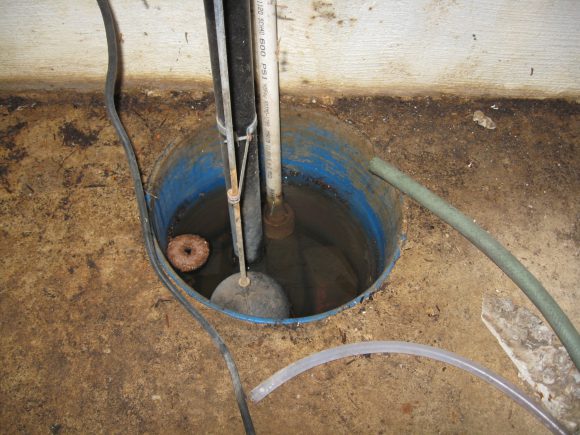
The sump pump danger

Please examine closely:

Potential mosquito breeding ground, right? Nice dirty stagnant water, gathering at the bottom of a bulkhead to be pumped out.

Can mosquitoes fly in? Certainly; no bulkhead is constructed tight enough to keep out a small insect.

Has the homeowner taken the right precautions?

Yes! Note the Bti larvicide tablet floating on the left side. Very good!

The mosquitoes are coming… to East Bradford!

Thanks to the East Bradford municipal administration for giving their residents useful guidelines for protection against breeding and being bitten by mosquitoes. The article below is from page 6 of the East Bradford summer 2017 newsletter.

In addition, East Bradford’s Environmental Advisory Council (EAC) has prepared further information which you can download at the EAC site, including a very thorough In-Depth Report and a Summary.

DSM wishes East Bradford residents as mosquito-free summer as possible!

s

Film & environment

Opportunity for film buffs:

Don’t Spray Me and Sierra Club Sustainability Committee are working with West Chester University to create an environmental film series to be rolled out this fall.

If you are interested in film and would like to join the group, please contact Margaret Hudgings, mhudgings@gmail.com.

Tire piles: mosquitoes’ favorite breeding ground

If you spot a pile of tires exposed to precipitation, please let us know. Tires, whether old or new, are mosquitoes’ best breeding territory, because they warm up in the sun and hold water long-term invisible to human eyes. N.b. in West Chester, tires should be stored inside, not  outside.

Excerpt from “What Tire Pile Owners Should Know About West Nile Virus” download at PA DEP:

Could a tire pile be a mosquito-breeding site?

Tire piles could provide suitable areas for mosquitoes to live, including those known to carry WNV. When discarded tires are allowed to accumulate even a small amount of water, they become attractive sites for mosquitoes to lay their eggs. For example, during the course of one season, thousands of mosquitoes can emerge from just one tire. If tires infested with mosquito eggs, larvae or pupae are transported, the potential to spread mosquito populations increases. This is one of the theories on how WNV was introduced into the United States.

How can a property owner prevent mosquito breeding?

It is the responsibility of the tire pile owners to make sure that the pile does not create a nuisance or health hazard. There are a number of ways to eliminate mosquito production in tire piles.

Standing water in the tires should be eliminated. This can be accomplished by properly storing tires under a tarp or other cover, removing the side wall, or drilling holes in the back of the tire.

In situations where eliminating mosquito production areas is not a practical alternative, larviciding is the most effective control technique….

read the full download here: Tire piles 3800-FS-DEP2535

Memorial Service for Graham Hudgings June 23

The Hudgings family cordially invites all supporters of Don’t Spray Me  to the memorial service for Graham Hudgings on Friday June 23rd in the meeting house on the campus of Westtown School at 11 in the morning.
The meeting house is not air conditioned so dress lightly and wear business casual. Dragons baseball players can wear their jerseys. Baseball hats can be worn after the service.
At the reception, kids are welcome to use the nearby fields to play wiffle ball. I will have all the equipment. Hopefully the weather will be good. Graham always wanted any event to be kid-friendly and informal so we hope that we will accomplish both!

The reception is adjacent to the meeting house and is air conditioned. There will be signs to direct traffic and attendants to assist with parking. There will be parking right in front of the meeting house for those that have mobility issues.

You can view this link for campus map and parking info.

See more about Graham here.

Lincoln County, OR, Adopts First-in-Nation Ban of Aerial Pesticide Spray


OREGON: The election results from Lincoln County, OR, are in: Lincoln residents adopted the first-in-the nation countywide Freedom from Aerial Sprayed Pesticides ordinance by 61 votes. Lincoln residents are the first in Oregon to secure people’s environmental and democratic rights, challenging the claimed “rights” of corporations. They are also the first to secure the rights of nature to exist and flourish, joining a growing number of communities across the U.S. and globally who are recognizing ecosystem rights. Measure 21-177 bans aerial sprayed pesticides as a violation of those rights.

The measure was ahead by 27 votes in the ballot count on election night (May 16th). However, there were 100 unsigned ballots that could still be counted towards the total. Those voters had until May 30th to sign their ballots, which were then added to the final count and secured the win.

Lincoln County residents have faced decades of toxic aerial pesticide spraying by the industrial timber industry. Timber corporations repeatedly aerial spray toxic pesticides on clearcuts to kill off “competing” vegetation and animals that threaten newly planted and young commodity crop trees. Residents have been working with the Community Environmental Legal Defense Fund (CELDF) since 2013 to protect themselves from the dangerous practice. …

read more at CELDF