Environment panel, Feb. 22, 2018

On Sunday, February 22nd, a coalition of environmental groups led by Don’t Spray Me! sponsored a panel of experts at the Unitarian Congregation of West Chester, with an audience of about 90 people.

After a cordial welcome by Rev. Dan Schatz, the three panelists spoke reflecting their own particular backgrounds:

• Richard Whiteford, environmental activist, a founder of the local Sierra Club branch, noted climate change speaker and writer, Board Member of World Information Transfer NGO, and participant in the Paris Climate Conference of 2015. Richard spoke to the unseemly subsidies that our government gives to the fossil fuel industry. That funding should go to renewables. Fortunately, he said, some states, universities and towns are stepping into the gap left by a delinquent US government.

• Dianne Herrin, Mayor of West Chester since January, founder of BLUER (a coalition of local leaders advocating for reducing carbon emissions), former head of the Borough’s Sustainability Advisory Committee, and initiator of the Environmental Bill of Rights passed by West Chester citizens. Among other themes, Dianne spoke to West Chester’s renewed commitment to urban trees and to the growing realization that nature has rights too. She also brought out that natural gas is not a “bridge to clean energy” and that Pennsylvania’s Public Utilities Commission is actually hostile to renewable sources of energy.

• Chrissy Houlahan, engineer and businesswoman, veteran, chemistry teacher, founding COO of B Lab to promote civic responsibility in companies, and a 2018 candidate for Congress. Chrissy emphasized that the legal framework exists for corporations to choose to be good environmental citizens (known as B-Corps: Benefit Corporations).

The panelists responded to audience questions ranging from issues related to pipeline safety to business responsibility to Paris Climate Agreement challenges.

Asked about local consequences of global warming, Richard Whiteford predicted an increasing likelihood of “rain bombs” (with something like 8″ of rain in 2-3 hours), species extermination, and the total breakdown of Philadelphia’s storm runoff system. Chrissy Houlahan added that climate refugees, particularly from Africa, will be causing worldwide dislocations.

Questions were sorted and posed by a non-partisan group including Matt Holliday, Elizabeth Moro and Jessica Cadorette.

As summarized by moderator Sheila Burke’s: participants feel a sense of urgency to solve environmental issues; people want to be involved; and we can be very heartened by the large number of people stepping forward.

Exhibitors at the display tables included Citizens Climate Lobby, Delco United for Pipeline Safety, Don’t Spray Me!, Food and Water Watch, Penn Environment, and the West Chester Co-operative.

It has been a goal of Don’t Spray Me! since its founding in 2015 to open up dialogue about environmental issues and to engage in community education. This event built on the environmental film series at WCU in the fall of 2017, which was created in collaboration with Sierra Club and the University’s Sustainability Program and was preceded by the Earth Day celebration of April 2017.

Photos by Taka Nagai
Tell the Environmental Protection Agency: Ban Roundup Now

Petition from Environmental Action

Since their peak in the mid-90s, monarch populations have decreased by 90 percent, in part due to the widespread use of Roundup and other toxic pesticides. Tell the U.S. Environmental Protection Agency to ban Roundup, so we can save this incredible insect before it’s too late.

The monarch butterfly is an iconic species that migrates through the heart of the United States each year. Unfortunately, the number of monarchs has decreased by 90 percent since their peak in the mid-90s.

Pollution-driven climate change is part of the problem. But we’re also allowing the destruction of milkweed — the monarchs’ main habitat and food source — through the rapid acceleration in use of Monsanto’s toxic Roundup and Roundup Ready crops.

Please stand with the millions of wildlife enthusiasts across the country in protecting this iconic species by banning Roundup.

Save the pollinators!

email from Friends of the Earth, 3/9/18. [N.b. Bayer also manufactures permanone, one of today’s mosquito sprays of choice. And, believe it or not, “In 1898, the Bayer pharmaceutical company began an aggressive marketing campaign to sell its commercial preparation of Heroin” (Narcanon; and search other sources). Who would trust such a company with our health and environment?]

Bayer the Bee-Slayer and Monsanto the Butterfly Killer are trying to merge into one giant pesticide corporation.

This would be a disaster for pollinators, people and the environment. Farmers overwhelmingly think this mega-merger is a bad idea — a new poll found 93 percent of farmers surveyed oppose it. Over 1 million Americans have called on the Justice Department to stop it. And there are investigations in both the EU and the U.S.

We need to make sure the Department of Justice doesn’t let this merger move forward. But we need your help to urge it to act.

Tell the Department of Justice to stop the Bayer-Monsanto merger!

If this merger goes through, the new company would be the world’s largest vegetable seed company. It would control seeds for many of the crops we eat regularly — including broccoli, carrots and onions.

It would also be the largest manufacturer and seller of herbicides. It would double down on making toxic chemicals like glyphosate (a.k.a. Roundup®) — which is a key culprit in monarch butterfly declines and is a probable human carcinogen.

What’s more, this merger threatens the development of a sustainable and just food system. It will hurt independent family farmers and rural economies and will encourage farmers to ramp up the chemically intensive agricultural system that Bayer and Monsanto promote.

In short, we’d be giving a single corporation unprecedented control of our food supply. We can’t let the future of our food system be handed over to Bayer and Monsanto.

The Department of Justice has the power to stop the proposed merger — but it won’t act unless you speak up.

sign the petition here

Tell your members of Congress to ban chlorpyrifos!

Friends of the Earth, 3/6/18, text of petition:

Dear legislator,

I am writing to urge you to cosponsor S.6124 / H.R. 3380, which would ban chlorpyrifos, a highly toxic nerve agent pesticide known to cause brain damage in children.

Chlorpyrifos is so dangerous that, after years of study,, the U.S. Environmental Protection Agency (EPA), based on the weight of the scientific evidence, was set to ban all uses of this pesticide in 2015. However, Environmental Protection Agency Administrator Scott Pruitt reversed the proposed ban.

Donald Trump’s administration has failed on this issue. The agency reversed its proposed ban on chlopryrifos after Dow delivered $1 million to Donald Trump’s inaugural committee. In addition, Trump picked Dow Chemical CEO Andrew Liveris to head the American Manufacturing Council. I’m also alarmed that the White House just announced that Trump plans to nominate Dow’s lawyer to lead EPA’s office of solid waste. That means a former Dow employee will be in charge of overseeing the toxic waste sites of his former employer.

The actions of the Trump administration signal that they are more concerned about protecting the interests of the pesticide industry than the American public. As your constituent I urge you to take leadership on this issue.

The science is clear: there are no safe uses of chlorpyrifos. Prenatal exposures to this chemical are associated with reduced IQ, loss of working memory, attention disorders and delayed motor development. Whenever chlorpyrifos is sprayed, it can cause immediate and long-term health harms to kids, farmers, farmworkers and others who are exposed.

In its latest risk assessment of chlorpyrifos, your agency’s scientists determined that:

• All food exposures exceed safe levels, with children ages 1-2 exposed to levels of chlorpyrifos that are 140 times what the EPA deems safe.
• There is no safe level of chlorpyrifos in drinking water.
• Chlorpyrifos is found at unsafe levels in the air at schools and homes in communities in agricultural areas.
• All workers who mix and apply chlorpyrifos are exposed to unsafe levels of the pesticide, even with maximum personal protective equipment and engineering controls.

There are effective alternatives for pest management that won’t poison our children.

We must protect ourselves and our children from this dangerous chemical.

Please cosponsor S.6124 / H.R. 3380 to demonstrate that you prioritize the interests of the American public over Dow’s corporate profits.

It’s not just pesticides and motor vehicles

Unfortunately, we are exposed to potentially harmful chemicals almost anywhere. The tension between regulation in the public interest and corporate sales plays out even in our homes.

See “Volatile chemical products emerging as largest petrochemical source of urban organic emissions” by Brian C. McDonald et al., Science, 16 Feb 2018: Vol. 359, Issue 6377, pp. 760-764.

According to the summary:

Air pollution evolution

Transport-derived emissions of volatile organic compounds (VOCs) have decreased owing to stricter controls on air pollution. This means that the relative importance of chemicals in pesticides, coatings, printing inks, adhesives, cleaning agents, and personal care products has increased. McDonald et al. show that these volatile chemical products now contribute fully one-half of emitted VOCs in 33 industrialized cities (see the Perspective by Lewis). Thus, the focus of efforts to mitigate ozone formation and toxic chemical burdens need to be adjusted.

When we talk to people about defending the environment, we need to mention that human well-being is inextricably related to environmental health. As the article’s very first sentence notes, “Exposure to air pollution is the fifth ranking human health risk factor globally, following malnutrition, dietary risks, high blood pressure, and tobacco.”

On that scale, details seem small, but perhaps it is time to pay attention to those warnings one reads about harmful chemicals in things like printed receipts, styrofoam cups, and cleaning sprays.

Read and download the full article here. Read more comment, see “Wall Paint, Perfumes and Cleaning Agents Are Polluting Our Air” by Rhitu Chatterjee, NPR, February 15, 2018.

Missouri Organic Family Farm Faces Ruin After Herbicide Drift

by Ken Roseboro, EcoWatch, 2/4/18

Herbicide drift has been a major problem last year damaging millions of acres of crops in the U.S.

An organic farmer in Missouri has seen firsthand how destructive herbicide drift can be as it destroys his crops and threatens his livelihood and farm.

Mike Brabo and his wife Carol own Vesterbrook Farm in Clarksville, Missouri, about an hour north of St. Louis near the Mississippi River. The farm has been in Carol’s family for nearly a century. The couple and their two children have worked the farm since 2008 after Mike survived thyroid cancer.

At that time Mike gained an appreciation for organic foods but found it difficult to afford them. “It’s expensive to buy organic fruits and vegetables at Whole Foods,” he said.

Mike and Carol decided to grow their own. It wasn’t difficult to convert the farm to organic since no chemicals had been used on the land….

read more at EcoWatch

Trump’s EPA could allow teenage workers to handle dangerous pesticides

by Doris Cellarius, Sierra Club Grassroots Network, 1/11/18, from Huffington Post. See both sites for links to more info.

If the Environmental Protection Agency follows through with a reform now under consideration, teenage farmworkers and other working minors would once again be allowed to handle dangerous pesticides while on the job.

The EPA is now reevaluating a 2015 rule that tightened safety standards for farmworkers. In particular, the agency is considering changing or scrapping the requirement that anyone working with pesticides in agriculture be at least 18 years old.

Doctors had called for those restrictions to be put in place because pesticides can increase the risk of cancer or impact brain development in children.

The EPA may also tweak or do away with the age requirements of another recent rule, which spells out who can be certified to be an applicator of the chemicals that the EPA classifies as the most toxic. That could make it legal for minors to work with what are known as “restricted-use” pesticides, like arsenic and methyl bromide, in a host of industries beyond just agriculture, such as landscaping and pest control.

Restricted-use pesticides are not sold to the public for general use because of how dangerous they can be to people and the environment.

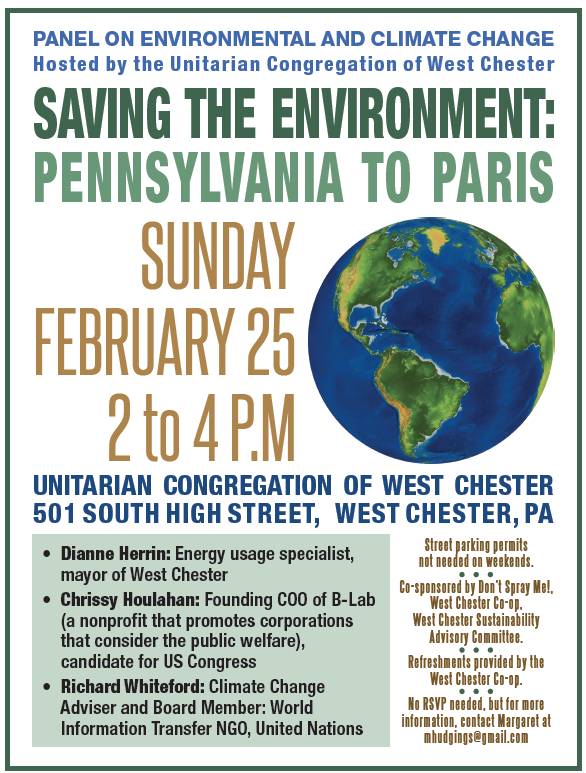
Saving the Environment: Pennsylvania to Paris

“Saving the Environment: Pennsylvania to Paris”: Feb. 25 2-4 p.m. panel on environmental and climate change at Unitarian Congregation, 501 S High St West Chester, PA 19382.

Environment, because we can’t do without it and must preserve it to preserve ourselves.

Pennsylvania, because that is where we are and can bring about change, and because Pennsylvania remains one of the most polluting states.

Paris, because the countries of the world came together in the 2015 Paris Agreement to pull the world back from increasing greenhouse gas emissions.

Speakers will be:

Dianne Herrin, energy usage specialist, mayor of West Chester

Chrissy Houlahan, founding COO of B-Lab (a nonprofit that promotes corporations that consider the public welfare); candidate for US Congress

Richard Whiteford, Climate Change Adviser and Board Member: World Information Transfer NGO, United Nations; participant, Paris Conference on climate, 2015

Audience questions will be channeled through 3 local figures with interest in the field: Jessica Cadorette, Matt Holliday, and Elizabeth Moro.

Hosted by Unitarian Congregation. Co-sponsored by Don’t Spray Me!, West Chester Co-op, West Chester Sustainability Advisory Committee. Refreshments provided by the West Chester Co-op.

Park on a nearby street or in the Sharpless Street Garage, 25 Sharpless St.

No RSVP needed, but for more information, contact Margaret at mhudgings@gmail.com.

Download pdf here to share with friends: Saving envt PA to Paris 2-25

The Politics of Infertility and Cancer

This article by Stacy Malkan, Huffington Post, 11/28/2017, is pretty shocking even by today’s standards. Some highlights:

Watch out for the Independent Women’s Forum, which despite its name is a front for right-wing causes supported by the Koch Brothers.

“Women can also benefit by ignoring “alarmist” concerns about toxic chemicals, according to an IWF lecture series sponsored by Monsanto.

“Moms who insist on organic food are arrogant, snobby “helicopter parents” who “need to be in control of everything when it comes to their kids, even the way food is grown and treated,” according to Julie Gunlock, director of IWF’s “Culture of Alarmism” project…”

One study cited shows that: “Glyphosate is a clear case of ‘regulatory capture’ by a corporation acting in its own financial interest while serious questions about public health remain in limbo. The record suggests that in 44 years—through eight presidential administrations—EPA management has never attempted to correct the problem. Indeed, the pesticide industry touts its forward-looking, modern technologies as it strives to keep its own research in the closet, and relies on questionable assumptions and outdated methods in regulatory toxicology.”

“The $800 billion chemical industry lavishes money on politicians and lobbies its way out of effective regulation. This has always been a problem, but now the Trump administration has gone so far as to choose chemical industry lobbyists to oversee environmental protections,” according to Nicholas Kristof.

The article presents many more examples of chemical industry malfeasance often covered up by its propaganda arms, sometimes with government collusion, but fortunately revealed by dedicated journalists and researchers.

The bottom line is no surprise: we must exercise constant vigilance and remain informed observers to protect ourselves and others.

Constant vigilance needed against dangerous chemicals

Who would sell products that could harm us? And safety regulations protect us, right? Answers: 1) People who want to make money and 2) Not as much as we might think.

Can someone sell you a recycled product that could blow up and kill you or contaminate you with toxins? Sure. Read “Empty industrial barrels bought on Craigslist present deadly dangers” by Rick Barrett at Milwaukee Journal Sentinel, 12/13/17.

Gasoline, other flammable chemicals, insecticides, and other toxins lurk in some used metal drums that can be bought online. At least 69 Americans have died from making such purchases in the past 15 years, according to the article.

Some of those dangerous chemicals are also lurking on the shelves of your local hardware store or maybe even in your own basement.

Read the labels, err on the side of caution, and don’t rely on someone else to warn you adequately or protect you and your family from harm.

New Year’s resolution: avoid dangerous chemicals!