West Chester Mayor Herrin vs. spraying

Excerpt from Bill Rettew, “Health Department set to spray for mosquitoes,” Daily Local News, 8/14/18:

“Spraying to control mosquitoes is still standard practice in many localities,” Herrin said, “but that doesn’t mean it works. The insecticide kills only adult mosquitoes, not larvae, and research suggests mosquito populations can bounce back quickly and even increase after an application.

“Research also suggests that rates of West Nile Virus cases are no different in cities that spray vs. those that do not. The Don’t Spray Me organization has done an excellent job helping our residents understand this and offering other, safer ways to help address the mosquito problem.”…

read the full article at Daily Local News

Against spraying

By a West Chester resident, 8/13/18

I just heard that the Chester County Health Department is planning to do mosquito spraying in much of the Borough this Thursday night (rain date on Monday night). You can find the press release at the County site once they upload it. It was emailed to me.

I am concerned about the spraying from a human and animal health perspective as well as from an environmental perspective. I am involved with a grassroots organization, Don’t Spray Me!, that has been expressing concern about the spraying for years.

Some things that have been uncovered are (and this is just some of what has been discovered):

1. They use a highly toxic pesticide that environmental groups have on their black list.

2. The research on the use of this pesticide has shown that it is highly ineffective as it only kills adult mosquitoes (and the eggs are still able to hatch) whose life cycle is only 2 weeks. The pesticide does harm and kill other beneficial creatures (like bats) that keep the mosquitoes in check. We should leave it up to Mother Nature to keep things in balance.

3. Most counties in PA and other states don’t have a spray program and they don’t have outbreaks of West Nile.

4. When this quadrant was sprayed about 6 years ago, the man who was driving the truck spraying admitted that he didn’t follow the manufacturer’s directions and he sprayed a higher concentration (he went up and down both streets and alleys) and they didn’t cover playground equipment or shut off the spray near water sources (like the manufacturer of the pesticide recommends). I am concerned that the pesticide was not applied safely or according to protocol.

5. We have questioned repeatedly how the Health Department determines their vector index (which is what they use to determine if they will spray or not). Our statistician has found many holes in their calculations and never gets an answer when asked. We recently found out that the man who calculates vector indices is no longer working at the Chester County Health Department.

6. We have repeatedly asked the Health Department to larvacide in areas that we know are an issue like the College Avenue Pumping Station. That is a non-toxic and effective way to address the mosquito population. They do not tell us what they do larvacide.

7. The pesticide is mixed with a catalyst which allows it to stick to the surfaces and therefore stick around for months, and some say for a year. I don’t want that on our streets, on our lawns, and then tracked into our houses. I wouldn’t eat vegetables from a garden after a spray.

I could go on and on but you get the idea. No one can argue that pesticides are safe. I think the general public is more concerned about autoimmune diseases and cancer than West Nile. Did you hear that a man who sued Monsanto was just awarded $289 million dollars because it was proved that his health issues were the result of using Round Up? And there are 4,000 more cases in the pipeline. People are waking up and fighting to protect themselves.

Don’t Spray Me! isn’t saying don’t protect us from West Nile but we are advocating for non-toxic and effective solutions!

If you feel the same way about this issue, you can take 3 actions:

1. Call and email Jeanne Casner, Director of the Chester County Health Department at 610-344-6225, jcasner@chesco.org TODAY!

2. Attend a meeting: Borough Council is holding an emergency meeting Tuesday, August 14th, to hear public comments and make a plan. The meeting will be at 7 p.m. in the Spellman Building (the previous location of West Chester School District Administration Offices), 829 Paoli Pike.

3. Share this message and the importance of attending the meeting with anyone you know.

Court Orders E.P.A. to Ban Chlorpyrifos, Pesticide Tied to Children’s Health Problems

By Eric Lipton, New York Times, Aug. 9, 2018

WASHINGTON — A federal appeals court ordered the Environmental Protection Agency on Thursday to bar within 60 days a widely used pesticide associated with developmental disabilities and other health problems in children, dealing the industry a major blow after it had successfully lobbied the Trump administration to reject a ban.

The order by the United States Court of Appeals for the Ninth Circuit came after a decade-long effort by environmental and public health groups to get the pesticide, chlorpyrifos, removed from the market. The product is used in more than 50 fruit, nut, cereal and vegetable crops including apples, almonds, oranges and broccoli, with more than 640,000 acres treated in California alone in 2016, the most recent year data is available.

In March 2017, just a month after he was confirmed as the agency’s administrator, Scott Pruitt rejected a petition by the health and environmental groups to ban the pesticide. He did so even though the agency’s own staff scientists had recommended that chlorpyrifos be removed from the market, based on health studies that had suggested it was harming children, particularly among farmworker families.

A three-judge panel, on a 2-to-1 vote, gave the agency two months to finalize the ban on the product, whose leading manufacturer is DowDuPont….

read more at New York Times

Mosquito control treatment scheduled for Parkesburg Borough to prevent West Nile Virus

[Note: we have often wondered how a pesticide can “prevent” a virus when it can’t even “prevent” mosquitoes. Note on the active ingredient deltamethrin from Wikipedia: “Resistance has been characterised in several insects, including important vectors of malaria like the mosquito Anopheles gambiae as well as non-disease carrying pests like bed bugs.” That is one of the problems with any pesticide: insects can become resistant to anything! Because of acquired resistance, Permanone (previously used in Chesco) could not be used in Miami during the recent Zika scare. If you live in the spray area, see how you can help us here.]

from Chesco Health Department pdf

West Chester, PA – The Chester County Health Department will conduct a mosquito control treatment spray in portions of Parkesburg (see map below). The treatment is scheduled for Thursday, August 9th from 8:00 pm to 11:30 pm. The rain date for this event is Monday, August 13th from 8:00pm to 11:30pm.

The Chester County Health Department conducts mosquito control treatment in areas with high levels of mosquito activity and where multiple mosquito samples have tested positive for West Nile Virus (WNV). After exhausting all other available mosquito control strategies, spraying is conducted to reduce residents’ risk of WNV infection. Anyone living in an area where mosquitoes are infected with WNV is at risk, but the risk of infection is highest for people who work outside or participate in outdoor activities. Less than 1% of people infected will develop serious illness. While serious illness can occur in people of any age, people over 60 years of age, people who have received organ transplants, and people with certain medical conditions such as cancer, diabetes, hypertension, and kidney disease are at the greatest risk for serious illness.

The Chester County Health Department uses a truck-mounted sprayer to apply .66 ounces of U.S. Environmental Protection Agency-approved product (DeltaGard) per acre of land….

read more in the Chesco Health Department pdf

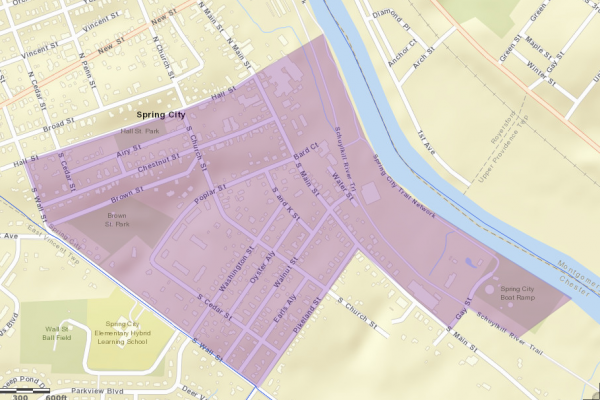
Mosquito control treatment scheduled for Spring City Borough to prevent West Nile Virus

release from Chesco Health Dept., 7/30/18

West Chester, PA – The Chester County Health Department will conduct a mosquito control treatment spray in portions of Spring City Borough (see maps below). The treatment is scheduled for Wednesday, August 1st from 8:00 pm to 11:30 pm. The rain date for this event is Monday, August 6th from 8:00 pm to 11:30 pm.

The Chester County Health Department conducts mosquito control treatment in areas with high levels of mosquito activity and where multiple mosquito samples have tested positive for West Nile Virus (WNV). After exhausting all other available mosquito control strategies, spraying is conducted to reduce residents’ risk of WNV infection. Anyone living in an area where mosquitoes are infected with WNV is at risk, but the risk of infection is highest for people who work outside or participate in outdoor activities. Less than 1% of people infected will develop serious illness. While serious illness can occur in people of any age, people over 60 years of age, people who have received organ transplants, and people with certain medical conditions such as cancer, diabetes, hypertension, and kidney disease are at the greatest risk for serious illness.

The Chester County Health Department uses a truck-mounted sprayer to apply .66 ounces of U.S. Environmental Protection Agency-approved product (DeltaGard) per acre of land…

text continues as usual; see here

Mosquito control treatment scheduled for Tredyffrin and Easttown Townships to prevent West Nile Virus

Update: spraying did occur on July 24 but now more spraying is scheduled for July 30 in the same areas.

Release from Chesco Health Department, 7/20/18. [The map there shows 4 spray areas, including one park, 2 residential areas, and one cemetery. As we have asked in the past, how does one “prevent” a virus? Residents of the affected area, please see Don’t Spray Me! needs your help when spraying occurs.]

West Chester, PA – The Chester County Health Department will conduct a mosquito control treatment spray in portions of Tredyffrin and Easttown Townships (see maps below). The treatment is scheduled for Tuesday, July 24th from 8:00 pm to 11:30 pm. The rain date for this event is Wednesday, July 25th from 8:00 pm to 11:30 pm.

The Chester County Health Department conducts mosquito control treatment in areas with high levels of mosquito activity and where multiple mosquito samples have tested positive for West Nile Virus (WNV). After exhausting all other available mosquito control strategies, spraying is conducted to reduce residents’ risk of WNV infection. Anyone living in an area where mosquitoes are infected with WNV is at risk, but the risk of infection is highest for people who work outside or participate in outdoor activities. Less than 1% of people infected will develop serious illness. While serious illness can occur in people of any age, people over 60 years of age, people who have received organ transplants, and people with certain medical conditions such as cancer, diabetes, hypertension, and kidney disease are at the greatest risk for serious illness.

The Chester County Health Department uses a truck-mounted sprayer to apply .66 ounces of U.S. Environmental Protection Agency-approved product (DeltaGard) per acre of land. The mosquito control spray becomes inactive in just a few hours or with sunshine. Sprays are conducted after sunset, when mosquitoes are most active and bees have returned to their hives. Sprayers are turned off near bodies of water and apiaries to protect aquatic life and bees. The Chester County Health Department also notifies registered beekeepers and residents who are listed as hypersensitive in a designated spray area prior to conducting a spray. People who are concerned about exposure to mosquito control products can reduce their potential for exposure by staying indoors with children and pets when their neighborhood is being sprayed….

read more at Chesco Health Department

In case of spraying: Help us / Help yourself

Whenever the Chesco Health Department plans a so-called “spraying event,” the public needs to observe to be sure that applicable procedures are scrupulously followed and that adverse effects are as limited as possible. In 2017, the Health Department agreed to give 48 hours notice before spraying (it was previously 24 hours). Even so, we find that most people in the spray area do not receive the information and that many municipalities do not take responsibility for relaying it to their citizens.

We encourage you to Sign up for the Health Department mailing list so you will get the maximum warning. But don’t count on this alone to find out.

Anyone in a spray area, please try to observe (without exposing yourself directly to spray) and let us know:

• The releases say: “After exhausting all other available mosquito control strategies…” Do you know of strategies taken by the Health Department in your locality, such as working with the municipal government to educate residents, larviciding suspect bodies of standing water, or alerting property owners whose properties may be violating the Health Department’s regulation against allowing mosquitoes to breed in standing water?

• Were adequate warnings posted on affected streets so residents and visitors will know to stay out of the way of the spray and take protective measures, such as closing windows, turning off wall air conditioners, and bringing children inside? If so, how long in advance?

• Did you observe people who were not aware of the recommended precautions (such as joggers entering the area, students returning from class, people returning from shopping or jobs, etc., during or right after spraying)?

• Was there a lead truck in front of the spray truck and did it use a loud speaker to warn any people outdoors to leave the immediate vicinity or go indoors?

• Did the truck spray more than once in any street or on any area? Does it crisscross any area, thus delivering an extra dose to some addresses?

• Was the spray shut off as the truck approached a stream or body of water and if so, how many feet away on either side?

• In the days after spraying, what difference do you notice in the number of mosquitoes and other insects such as honey bees and dragonflies? Please try to video or photograph any evidence.

• Did you notice any effect, either immediate or after a few days, on pets, frogs, birds, bees, fish, or bats? Please try to video or photograph any evidence.

• How long did it take for the adult mosquito population to get back to about what it was before?

DSM needs you to help protect people and the environment and to let public officials know what you think.

Please also note these precautionary measures, which we base on extensive readings:

Spraying is always supposed to occur in the evening because bees are less active then and, if they know what is good for them, return to their hives (for what happens when spray is not scheduled properly see here). Beekeepers who have hives in the spray area need to take protective measures, as just one bee bringing pesticide back to the hive can be disastrous.

During the spraying (and ideally till the next day) residents should shut windows and close off all ways that outside air can enter their house (such as wall air conditioners unless you can set them securely to recycle indoor air). Pets should be brought inside, as they can be sensitive to pesticides. Remove children’s toys that are outdoors, any outdoor furniture, and clothes from outdoor clotheslines. The next day any furniture and outdoor play equipment should be washed off with soap and water before anyone comes in contact with it.

People who have a high level of chemical sensitivity may wish to plan an absence overnight or longer. To sign up for the Pesticide Hypersensitivity Registry (which gives you notification of not only County spraying but also commercial spraying in your vicinity), see here.

Mosquito control treatment scheduled for Uwchlan Township to prevent West Nile Virus

[n.b. rescheduled to July 26 due to weather]

Release from Chester County Health Department, 7/23/18 [The map there, copied below, shows a sizable residential area including 3 parks. As we have asked in the past, how does one “prevent” a virus? Residents of the affected area, please see Don’t Spray Me! needs your help when spraying occurs.]

West Chester, PA – The Chester County Health Department will conduct a mosquito control treatment spray in a portion of Uwchlan Township (see maps below). The treatment is scheduled for Wednesday, July 25th from 8:00 pm to 11:30 pm. The rain date for this event is Thursday, July 26th from 8:00 pm to 11:30 pm.

The Chester County Health Department conducts mosquito control treatment in areas with high levels of mosquito activity and where multiple mosquito samples have tested positive for West Nile Virus (WNV). After exhausting all other available mosquito control strategies, spraying is conducted to reduce residents’ risk of WNV infection. Anyone living in an area where mosquitoes are infected with WNV is at risk, but the risk of infection is highest for people who work outside or participate in outdoor activities. Less than 1% of people infected will develop serious illness. While serious illness can occur in people of any age, people over 60 years of age, people who have received organ transplants, and people with certain medical conditions such as cancer, diabetes, hypertension, and kidney disease are at the greatest risk for serious illness….

read more at http://hosted-p0.vresp.com/434903/54e5dbdaa2/ARCHIVE

Mosquito control treatment scheduled for Spring City Borough

[Note: as on all spraying events residents of the affected area please see Don’t Spray Me! needs your help when spraying occurs.]

Press release, Chesco Health Department, Sep 21, 2017

West Chester, PA – The Chester County Health Department will conduct a mosquito control treatment spray in portions of Spring City Borough (map of treatment area). The treatment is scheduled for Monday, September 25th from 7:15 pm to 10:15 pm. The rain date for this event is Tuesday, September 26th from 7:15 pm to 10:15 pm.

The Chester County Health Department conducts mosquito control treatment in areas with high levels of mosquito activity and where multiple mosquito samples have tested positive for West Nile Virus (WNV). After exhausting all other available mosquito control strategies, spraying is conducted to reduce residents’ risk of WNV infection….

To read more, download the full release at Chesco Health Department or here: 15_2017_WNV_SpringCitySpray

“Mosquito control treatment scheduled for East Bradford Township to prevent West Nile Virus”

[Note: as on all spraying events residents of the affected area please see Don’t Spray Me! needs your help when spraying occurs. Above is the County’s title. Can anyone explain to us how one treatment can “prevent” a virus?]

Press release, Chesco Health Department, Sep 5, 2017 3:52 PM

West Chester, PA – The Chester County Health Department will conduct a mosquito control treatment spray in portions of East Bradford Township (map of treatment area). The treatment is scheduled for Thursday, September 7th from 7:45 pm to 11:00 pm. The rain date for this event is Tuesday, September 12th from 7:45 pm to 11:00 pm.

The Chester County Health Department conducts mosquito control treatment in areas with high levels of mosquito activity and where multiple mosquito samples have tested positive for West Nile Virus (WNV). After exhausting all other available mosquito control strategies, spraying is conducted to reduce residents’ risk of WNV infection. Anyone living in an area where mosquitoes are infected with WNV is at risk, but the risk of infection is highest for people who work outside or participate in outdoor activities. Less than 1% of people infected will develop serious illness. While serious illness can occur in people of any age, people over 60 years of age, people who have received organ transplants, and people with certain medical conditions such as cancer, diabetes, hypertension, and kidney disease are at the greatest risk for serious illness.

The Chester County Health Department uses a truck-mounted sprayer to apply .66 ounces of U.S. Environmental Protection Agency-approved product (DeltaGard) per acre of land. The mosquito control spray becomes inactive in just a few hours or with sunshine. Sprays are conducted after sunset, when mosquitoes are most active and bees have returned to their hives. Sprayers are turned off near bodies of water and apiaries to protect aquatic life and bees. The Chester County Health Department also notifies registered beekeepers and residents who are listed as hypersensitive in a designated spray area prior to conducting a spray. People who are concerned about exposure to mosquito control products can reduce their potential for exposure by staying indoors with children and pets when their neighborhood is being sprayed. If you would like to take extra precautions after the spray is completed, you can rinse off outdoor furniture or playground equipment before use.

Although spraying helps to reduce mosquito populations, the Chester County Health Department encourages residents to “Make You and Your Home a Bite-Free Zone” to prevent WNV and other mosquito-borne diseases. Because mosquito-borne diseases are spread through the bite of an infected mosquito, residents can reduce their risk by using insect repellent and other personal protection and getting rid of standing water on their property….

Continue reading