DSM opposes toxic pesticides and herbicides and promotes natural gardening and healthy food. Please like us in Facebook at dontsprayme. Do your part: larvicide stagnant water that you can't dump out!
Don’t Spray Me! is one of several groups that comprise the West Chester Green Team in Chester County PA. Please click HERE to see that site.
We will still be posting initiatives against herbicides, pesticides, and chemical dangers on the Don’t Spray Me! site and Facebook, as well as in the Green Team’s outlets. The Green Team calendar below includes Don’t Spray Me! initiatives. See also the broader Chesco Environment Calendar HERE.
If you wish to help us or find out more info, please email us HERE.
Click on event to expand info. If you can’t see the calendar above, click here.
Of course, all species are part of nature and part of the food chain. But birds, bats and others who consume mosquitoes must have more than their fill by now, and spotted lanternflies have no predators here. What can we do to cut down on the excess?
This red-bottomed bird bath in West Chester has mosquito eggs (the grain-like spots among the debris) floating on the surface. In another day, the eggs will hatch into larvae which will grow to about 3/8 inch long; they come to the surface to breathe, but forage for food farther down and will wriggle about if you tap the bird bath. A few more days and they become pupae, which look like small stalks hanging from the surface. Another day or two and the adult mosquitoes will emerge, spread its wings and fly away.
What do we do about it? Tip the water out of the bird bath (and all other sources of stagnant water) every few days!
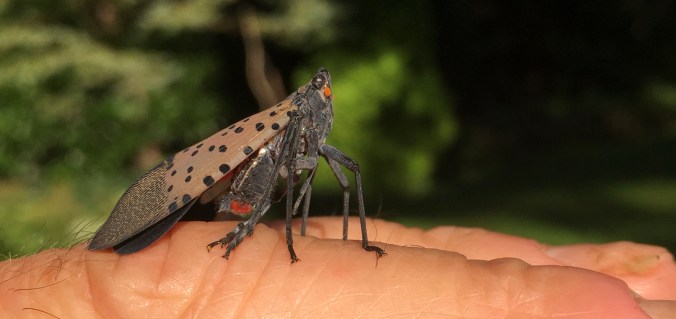
Spotted lanternflies are a recent invasive species; their point of diffusion in the US seems to have been our part of Pennsylvania in about 2012. They have an attractive and even exotic look with some of their developmental phases (instars) being black with white spots and others featuring red. They suck sap from the stems of trees, some agricultural crops, shrubs like roses, and even lace vines. They favor newer, more tender growth… right where they (and their sticky excretions that host a blackish mold and the leaking sap that attracts other insects) do the most harm.
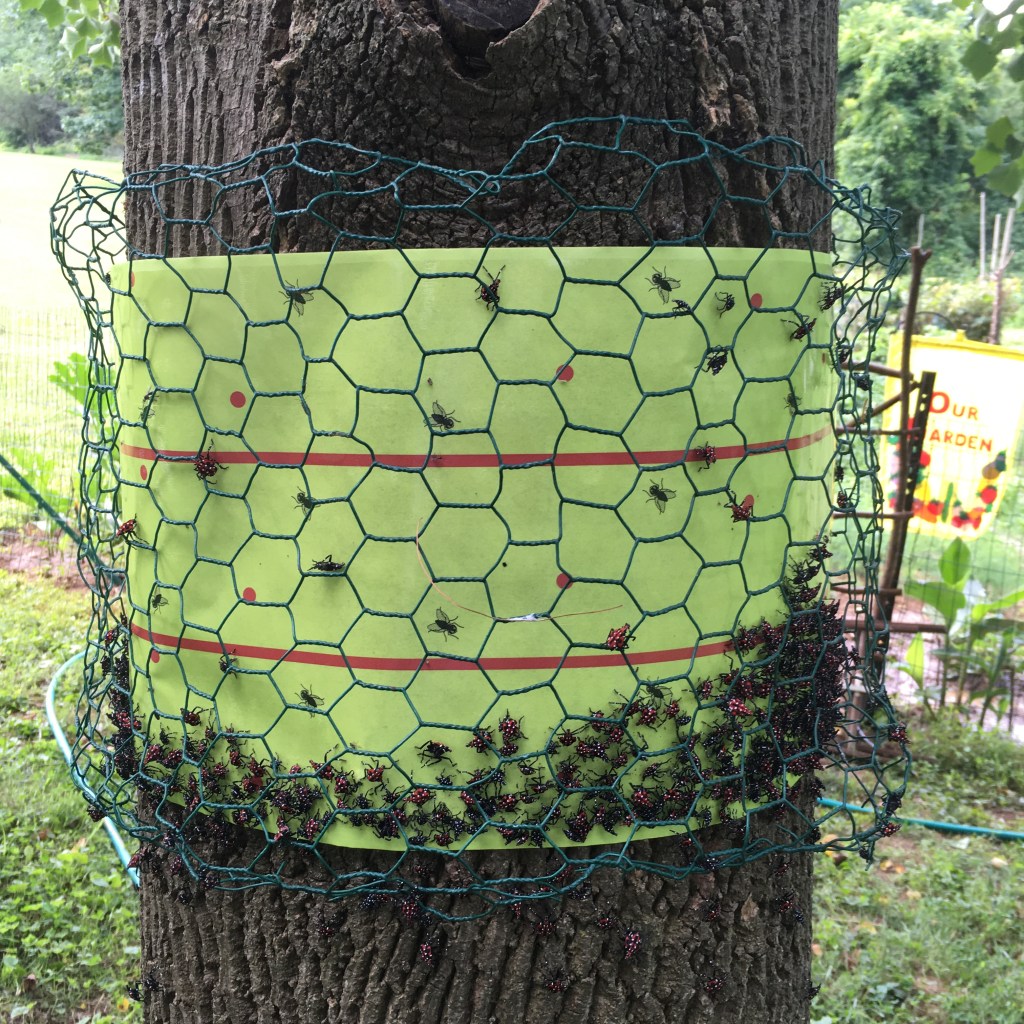
What do we do about it? The most environmental solution is to apply a band of sticky tape around any tree they are trying to crawl up. Only the adult phase has wings, and even those hop more than they fly; but they are very agile and hard to catch or squash. However, they definitely do not like being sprayed with a solution of dish soap and water; if you have an old spray bottle, that sends them hopping away and, after several applications, seems to deter them from returning to the same site.
The photo, from East Bradford, shows an early morning’s catch; by evening, the tape was entirely covered. You can almost feel sorry for them as you hear the crackling noise, like Rice Krispies in milk, of hundreds of feet lifting off the sticky tape, to no avail since all of the other 5 feet remain stuck. But do they feel sorry for the damage they do?
(If you use tape, be sure to cover it with chicken wire, as shown, to prevent birds from getting stuck as well.)
You might even think they are sort of cute… until you notice their tarry excretions killing everything underneath where they are sucking the sap of, in this case, a birch tree. Free Roundup, anyone?
Congratulations to our Gardening Programs Coordinator Courtney Bodle, who has worked with us on many issues for a year and a half now, on her well-deserved recognition by West Chester University’s Center for Community Solutions (CCS), as below:
During World Wars I and II, Americans pitched in to grow a lot of their vegetables at home or in shared gardens. Now we are faced with a similar need, because people hesitate to go shopping, delivery is slow, store-bought products can come bearing viruses (to say nothing of pesticides and herbicides), growing our own food saves money, and it is healthful and educational to get outdoors and plant!
Photo: Kale (which you can plant outside now) and wild onions (which you can gather any time), from West Chester Green TeamCourtney Bodle’s Instagram page.
To get your own organic veggie garden started, see Courtney’s regular series of videos on how to plant seeds indoors under grow lights and, as the season develops, further steps in growing, harvesting, and eating.
And let’s not forget composting. Why buy soil when you can make it at home? For tips, see West Chester resident and Borough Council member Denise Polk’s TED talk on YouTube.
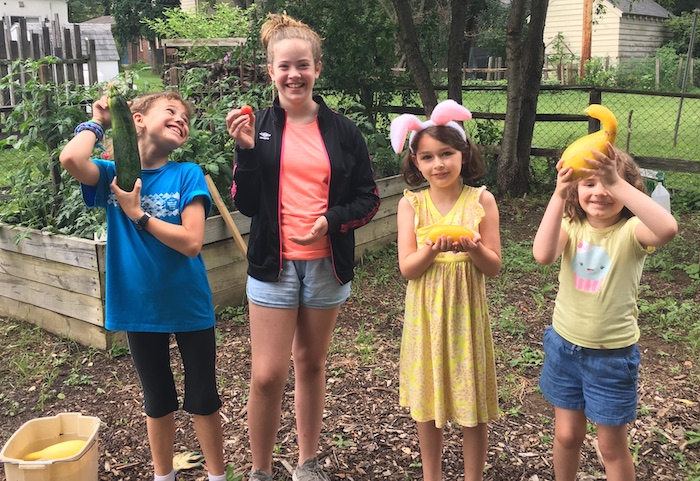
Please note that we plan on starting up our “kid gardening program” as soon as feasible this summer. For last year’s program, see photos on the West Chester Green Team site.
The Victory Garden movement is gaining prominence in the news; see for example an interesting historical perspective in “Food Supply Anxiety Brings Back Victory Gardens” by Tejal Rao in The New York Times, 3/25/20.
For seasonal information on edible wild plants, please see here and links from there. What’s not to like: you just go outside, gather, and eat!
So, once again in the current “war” on the virus: On To Victory!
by Nathaniel Smith, Politics : A View from West Chester, 3/25/20 {Featuring shepherd’s purse, which you can add to your salads right now, and day lilies]
This is a good time to be getting outdoors, not only because of the mostly warming weather, but because it takes our minds off the cares of the world.
This is also a good time to study up on edible wild plants, which offer us free green vegetables without having to go far afield. Do shepherd’s purse, common orange day lilies, dandelion, broadleaf plantain, and ostrich ferns appeal to you? I can vouch for them all.
Wherever you gather plants, be sure herbicides and pesticides have not been used….
For years, Toni Genberg assumed a healthy garden was a healthy habitat. That’s how she approached the landscaping around her home in northern Virginia. On trips to the local gardening center, she would privilege aesthetics, buying whatever looked pretty, “which was typically ornamental or invasive plants,” she says. Then, in 2014, Genberg attended a talk by Doug Tallamy, a professor of entomology at the University of Delaware. “I learned I was actually starving our wildlife,” she says.
The problem, Tallamy explained, is with the picky diets of plant-eating insects. Most of these bugs—roughly 90%—eat and reproduce on only certain native plant species, specifically those with whom they share an evolutionary history. Without these carefully tuned adaptations of specific plants, insect populations suffer. And because bugs themselves are a key food source for birds, rodents, amphibians, and other critters, that dependence on natives—and the consequences of not having them—works its way up the food chain. Over time, landscapes that consist mainly of invasive or nonnative plants could become dead zones.
Toni Genberg’s 0.24-acre Virginia property is certified as Audubon at Home habitat, which means its native plants make it a beneficial location for birds, insects, butterflies, and animals. Photo by Toni Genberg
On Saturday, June 29th, about 100 West Chester residents toured organic gardens in the West Chester borough. Gardens that were toured showcased vegetables, flowers, rain gardens, tower gardens, and much more. The goal of the tour was to educate residents about the many different types of gardens they can have, even in a small space.
A popular attraction of the tour was Councilwoman Denise Polk’s backyard. Although Polk only has less than one-tenth of an acre, the space boasts more than 50 different plantings, in addition to a honey bee house. Polk suggests eating veggies fresh off the vine, and keeping chemical use to a minimum or not at all. (Photo by Bill Rettew: “Checking out Councilwoman Denise Polk’s backyard organic garden”)
In total there were 10 stops along the tour, with at least one site in each ward of the borough: in backyards, at West Chester University, and at the Melton Center.
Margaret Hudgings is an active West Chester Green Team leader, and she helped to organize the event. She was excited to see that a main goal of the tour had been accomplished; “The tour shows people that you can have a fantastic garden even if you have a small yard.”
West Chester Green Team plans to run this tour again next year, with some changes and new gardens featured.
West Chester borough is full of beautiful and vivacious gardens you may not even know about! Come along June 29th for a tour of the organic gardens of West Chester, sponsored by the West Chester Green Team and West Chester University’s Office of Sustainability. A food garden from every ward of the borough will be featured, including West Chester University’s vegetable gardens, plus a rain garden installed by the Borough.
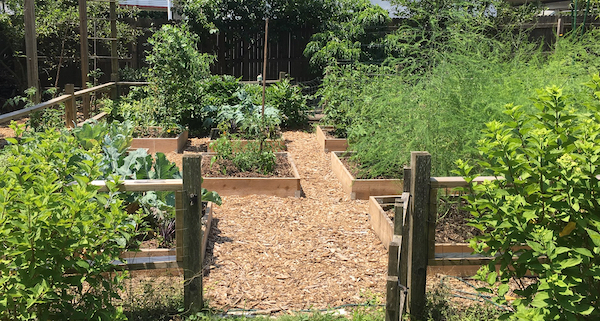
A sample of one of the gardens you will get to visit on the tour, growing here (all organically!): Asparagus, lettuce, kale, beans, and much more.
You will have the opportunity to meet greeters with information about each garden, and ask any questions you may have. If you’re looking for inspiration or help with your own gardens, this is the tour to go on!
The event is taking place June 29th, 11am-3pm. The tour route is posted below so that you can walk, bike, or drive to the gardens at your own pace. Or, hop in our van at noon at WC Friends Meeting, 425 N. High St.! The event is 100% FREE.
Courtney Bodle, an organizer of the event, says “this is a casual event… a day full of fun and light gardening education. A day to meet like-minded people, talk about green ideas, and work towards a sustainable future…. “!







 dontsprayme