Schools and parks in West Chester Borough

Don’t Spray Me! believes pesticides and herbicides should not be sprayed on any sort of educational institution or in parks where the public, including children, may go unawares shortly after spraying. The PA School Code requires notification of families and employees of public schools before spraying occurs–but not of private, independent and religious schools. This limitation is particularly upsetting because the youngest and therefore most vulnerable children, those in day schools and pre-schools, are specifically not protected by the law.

The map below, by Paige Vermeulen, shows schools (from day cares to university) in yellow, parks in green, and a 300 foot buffer zone in orange. Why 300 feet? Because spray drifts, and Bayer says its product DeltaGard kills mosquitoes at 300 feet (see more here).

PA Public School Code sections on pesticide notification

[DSM note: the 2 sections below, added in 2002, are valuable in showing that the Commonwealth has recognized the value of protecting children in school settings against exposure to harmful pesticides and herbicides.]

PUBLIC SCHOOL CODE OF 1949
Excerpts re pesticides: sections 772.1 and 772.2PUBLIC SCHOOL CODE OF 1949 Act of Mar. 10, 1949, P.L. 30, No. 14 [as amended] 

Section 772.1.  Integrated Pest Management Programs.–a) Each school shall, by January 1, 2003, adopt an integrated pest management plan in accordance with the integrated pest management policies established by the department on the effective date of this section until regulations are promulgated by the department…

[DSM summary: The Department of Agriculture shall “maintain a hypersensitivity registry to assist in the notification of students and employes who are especially sensitive to pesticides” (defined to include herbicides) and work with schools for that purpose. A school is defined as “a school district, an intermediate unit, an area vocational-technical school or any of these entities acting jointly.”]

Section 772.2.  Notification of Pesticide Treatments at Schools.–(a)  The following apply to pesticide applicators:

(1)  For a pesticide treatment at a school building, the certified applicator or pesticide application technician shall supply the pest control information sheet and a pest control sign, which must be at least eight and one-half by eleven (8 1/2 by 11) inches in size, to the chief administrator or building manager.

(2)  For a pesticide treatment on school grounds, including athletic fields and playgrounds, the certified applicator or pesticide application technician shall supply the pest control information sheet and a pest control sign, which must be at least eight and one-half by eleven (8 1/2 by 11) inches in size, to the chief administrator or grounds manager.

(b)  Responsibilities of schools are as follows:

(1)  Except as provided in clause (3), notification of pesticide treatments shall be as follows:

(i)  For a pesticide treatment at a school building, the school shall be responsible for all of the following:

(A)  Posting the pest control sign received under subsection (a)(1) in an area of common access where individuals are likely to view the sign on a regular basis at least seventy-two (72) hours before and for at least two (2) days following each planned treatment.

(B)  Providing the pest control information sheet received under subsection (a)(1) to every individual working in the school building at least seventy-two (72) hours before each planned treatment.

(C)  Providing notice, including the name, address and telephone number of the applicator providing the treatment, day of treatment and pesticide to be utilized, to the parents or guardians of students enrolled in the school at least seventy-two (72) hours before each planned treatment as follows:

(I)  notice to all parents or guardians utilizing normal school communications procedures; or

(II)  notice to a list of interested parents or guardians who at the beginning of each school year or upon the child’s enrollment requested notification of individual application of pesticides….

[DSM summary: Pesticide (including herbicide) applicators must supply information about the pest control chemical plus a sign. The school must, at least 72 hours before the planned treatment, post the sign and provide the pest control information sheet to all working in the building plus all parents of students (or all parents who have requested notification, if the school sets up a notification system. Also, ” pesticides may not be applied within a school building where students are expected to be present for normal academic instruction or organized extracurricular activities within seven (7) hours following the application or on school grounds where students will be in the immediate vicinity for normal academic instruction or organized extracurricular activities within seven (7) hours following the application.

Notification requirements to schools and families are extensive enough that spraying agencies and companies would just rather not spray than go through the required process and stir up rightful public concern about their operations around the young.]

[Download the full wording of both sections here: School Code PA pesticides 772. See the PA Department of Agriculture summary of the law here.]


Study suggests Roundup’s adverse effects on future generations

A recent study about rats could have implications for humans. It shows that even when exposure to the herbicide glyphosate (the main active ingredient in Roundup, but also used in other products since the patent US expired in 2000) is low enough not to do evident damage to individual rats, their offspring in the 2nd and 3rd generations may suffer epigenetic effects, meaning that although DNA sequences are not affected, the way the body instructs genes to act may be affected, notably in sperm cells.

Thus, even apart from any effects on the exposed individual humans (witness the recent large court judgments about Bayer-Monsanto), grandchildren and great grand-children may suffer adverse health conditions. Since glyphosate entered the market 43 years ago, children whose grandparents used the product may soon, unfortunately, be observed as test cases.

If this follows the route of tobacco and opioids, after decades of human suffering, government will suddenly find itself “shocked” and start trying to hold companies responsible–with little help for the humans affected, and small impact on the companies’ bottom line or executive leaders.

Below is the official summary of an article in Scientific Reports, volume 9, Article number: 6372 (2019)l read the full article there. See more background on harmful effects of Roundup in “Take Action by September 3 to Ban This Cancer-Causing Weedkiller!” at Organic Consumers Association (accompanying photo is from there).

Assessment of Glyphosate Induced Epigenetic Transgenerational Inheritance of Pathologies and Sperm Epimutations: Generational Toxicology

Abstract

Ancestral environmental exposures to a variety of factors and toxicants have been shown to promote the epigenetic transgenerational inheritance of adult onset disease. One of the most widely used agricultural pesticides worldwide is the herbicide glyphosate (N-(phosphonomethyl)glycine), commonly known as Roundup. There are an increasing number of conflicting reports regarding the direct exposure toxicity (risk) of glyphosate, but no rigorous investigations on the generational actions. The current study using a transient exposure of gestating F0 generation female rats found negligible impacts of glyphosate on the directly exposed F0 generation, or F1 generation offspring pathology. In contrast, dramatic increases in pathologies in the F2 generation grand-offspring, and F3 transgenerational great-grand-offspring were observed. The transgenerational pathologies observed include prostate disease, obesity, kidney disease, ovarian disease, and parturition (birth) abnormalities. Epigenetic analysis of the F1, F2 and F3 generation sperm identified differential DNA methylation regions (DMRs). A number of DMR associated genes were identified and previously shown to be involved in pathologies. Therefore, we propose glyphosate can induce the transgenerational inheritance of disease and germline (e.g. sperm) epimutations. Observations suggest the generational toxicology of glyphosate needs to be considered in the disease etiology of future generations.

The Biggest Little Farm (film) Nov. 20 at WCU

Room 102, Mitchell Hall, WCU, West Chester PA 19382. Nov. 20, 7:30 pm.

The Biggest Little Farm is a story about two people who left the city behind in an effort to revitalize barren farm land and live more harmoniously with the earth. This recently released film has been generating a lot of excitement for its inspiring tale and gorgeous cinematography.

Sponsored by the Office of Sustainability, the Slow Food Club, and the West Chester Green Team. See trailer at https://www.biggestlittlefarmmovie.com/videos/.

Free and open to the public.

Monsanto’s Hit List

email from Organic Consumers Association, 8/24/19

We’ve known since at least June that Monsanto, now owned by Bayer, compiled hit lists containing hundreds of names and other personal information about journalists, politicians and scientists, including their opinions about pesticides and genetic engineering.

But newly revealed court documents expose an even more calculated and sinister plan—a 130-page plan involving 11 staff members plus high-powered public relations firms—to “slime and slander” anyone who criticized their products or operations.

Among the targets of Monsanto’s hit list strategy is U.S. Right to Know (USRTK), a nonprofit investigative research group focused on the food industry, for which OCA provides substantial funding….

read more on Mayer-Monsanto’s nefarious tactics in “Monsanto Hit List Exposed” at Organic Consumers Association

Monsanto And The EPA

from PennPIRG

So far, the Environmental Protection Agency (EPA) and many other decision-makers have largely been taking Monsanto at its word when it claims its product is safe. But Monsanto has not been transparent about the potential health effects of Roundup. In 2017, Monsanto was caught ghost-writing studies for “independent scientists” to show that glyphosate, the main ingredient in Roundup, is safe, and in late 2017, newly unsealed court documents showed Monsanto has had an influence on U.S. regulators in the EPA for years, while suppressing scientific information about the potential dangers of its widely used pesticide, Roundup.

Even without these deceptive actions, there is enough evidence to indicate that we shouldn’t be needlessly exposing ourselves to something that has the potential to cause such serious harm. But that is exactly what we are doing, and in a big way. …

read more at PennPIRG

Where’s the Chesco Health Dept. when people really need it?

According to Chester County Coroner Dr. Christina VandePol (download the Aug. 2 press release here),

The Chester County Coroner’s Office is releasing data on drug overdose deaths in Chester County from January 1, 2019 through June 30, 2019. A total of 65 people have been confirmed to have died of a drug overdose during this period, with 62 deaths determined to be accidental and 3 due to suicide. …

Something seems amiss in how the County organizes its services! The Health Department does not deal with this major health epidemic, but when you look at the Health Department home page you find under “Environmental Services”:

New Fees for Food and other Establishments (Effective May 1st, 2019)
Housing, Insect, and Vector Concerns
Spotted Lanternfly Information
Public Bathing Places
Emergency Action Plan for Food Establishments
Healthy Stream Recreation
Farmers’ Market Guidelines
Temporary Event Application
Food Establishments
Sewage and Water
Request Existing Sewage/Well Permit

What does the spotted lanternfly have to do with human health? Why does the Health Department spend $200,000+ a year on mosquito control when the chief mosquito-related health problem it cites, West Nile Virus, has never caused one fatal case acquired in Chester County, compared to thousands of fatal opioid overdoses?

In the Health Department’s “A-Z Health Topic List,” you can find bats and dog licenses, and even Zika Virus (which is not transmitted by insects this far north), but no link to information about an epidemic that is killing an average of 2.5 people a week in Chester County! (You’d think Drug and Alcohol Services would feature itt, but good luck finding even one reference to fentanyl there.)

Why doesn’t the County have an Environment Department, with trained experts in environment and sustainability, to deal with concerns like over-proliferation of some species and existential threats to others, climate change, excessive water runoff, stream erosion, air and water pollution, environmental degradation from trash and especially single-use plastics, renewable energy, and so much more?

Then the Health Department could focus on its job: health.

How hot can mosquito larvae survive?

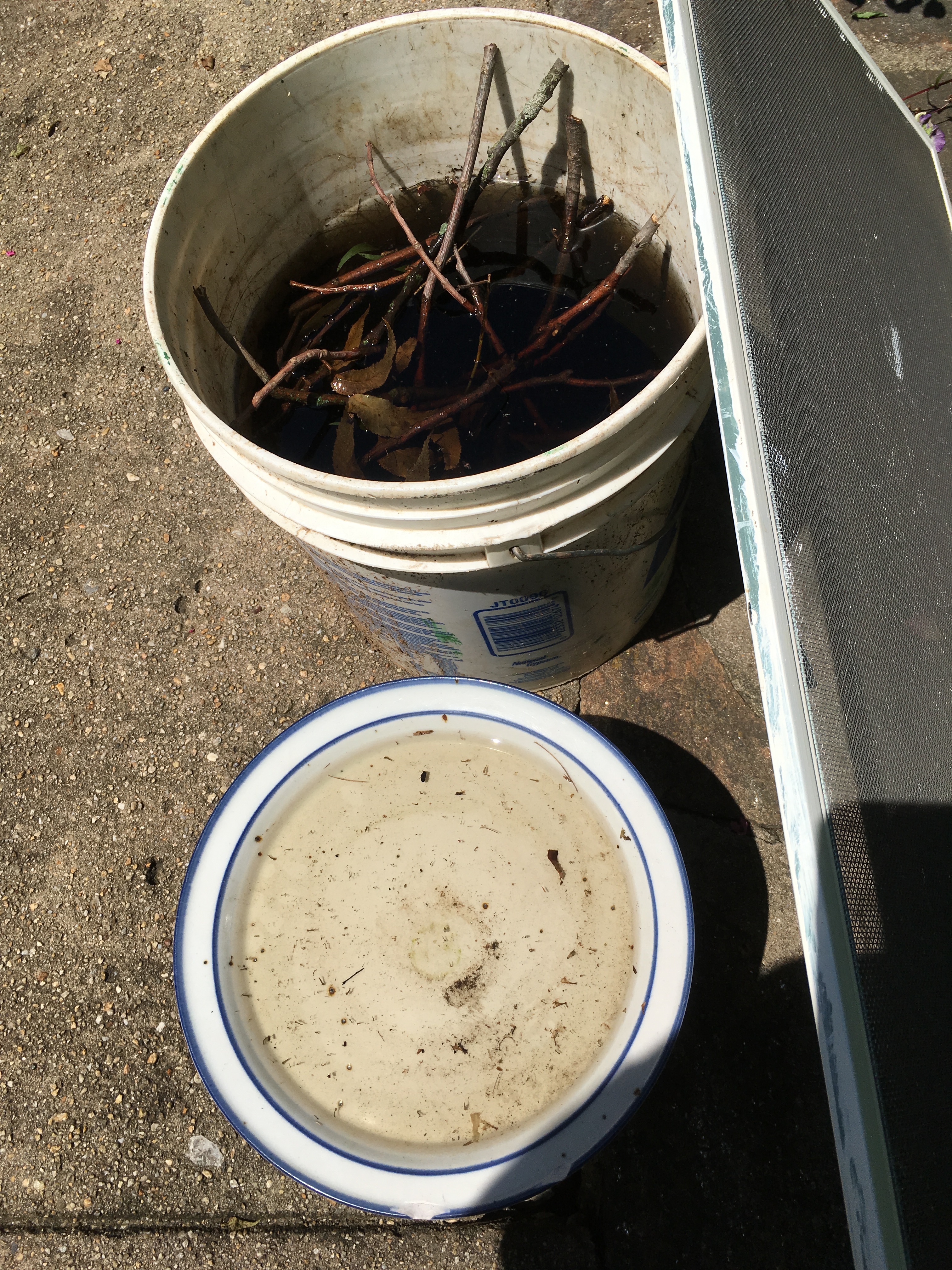
Is it cruel to find out? I hope not. I profited from the ultra-hot sunny weather to bring a pail of organic-laden water with larvae happily snapping around, onto my back patio in full sun. I then ladled some water with larvae into a plate with about 3/8″ of water. You see both in the photo:

Within 25 minutes, all larvae in the plate at 115F had expired. Within an hour and a half, almost all those in the pail had kicked the bucket, at 100F surface temperature. (Larvae have to spend much of their time at the surface to breathe, though they dive if provoked.)

At the right of the photo you see the screen that after the experiment I put over the bucket, to be sure no adult mosquitoes can emerge, but I think by tomorrow any surviving larvae probably will be done for too.

This little exercise has practical value: we can conclude that in weather like this, larvae will not survive in a shallow pool on a flat roof (similar to the plate) and that even in deeper water exposed to the sun as in a roofline gutter, they have little chance.

Of course, we shouldn’t take it for granted and, bearing in mind that 100F is not normal here, we should keep flat roofs and gutters free of stagnant water!

Next afternoon update: there are in fact a few survivors, despite similar air (95) and water (100+) temps. Survival of the fittest, I guess. Those I spotted are on the small side; maybe the closer they are to pupating, the less resistant to heat?

Last observation: Air this hot deters mosquitoes on the wing. We know they like shade; maybe they shrivel up in sun over 90 degrees? Too bad that sunny and 95 are not great conditions for humans to be out in the garden either!

DeltaGard: worrisome specifications

Even if your street isn’t sprayed, don’t think you don’t need to take precautions!

A nearby DeltaGard applicator specialist working with Bayer products and with several decades’ experience in the business, but who does not wish to be identified, tells us the spray can drift 300 feet and does not tend to dissipate into the air. Of course, exactly where it goes depends on wind direction and speed. The manufacturer’s information documents high mosquito kill rates at 300 and even 400 feet.

A 2015 EPA memo (download here: EPA deltamethrin-mosquito-adulticide takes as well-founded Bayer’s “mortality” rate as “100% for deltamethrin, even at 300 feet from the point of application.”

This is why we are calling for a buffer zone of at least 300 feet around vulnerable non-targets, such as children in schools and day care centers, registered hypersensitive individuals, bee hives, and bodies of water where fish and amphibians are sickened or killed by pesticides. If mosquitoes are exterminated at that distance, the toxins are a danger to other species as well, including humans, and we know that smaller children are more vulnerable than most adults.

The above-mentioned mortality rate, as the EPA points out, is for “easily controlled” mosquito species as opposed to “those with more widespread resistance to organophosphates and/or pyrethroids.” Naturally, the more that mosquitoes are sprayed with a given pesticide, the more they become resistant to it. Such acquired resistance is a very good reason not to spray at all unless there is a serious health emergency, which becomes more likely as our climate warms and new-to-us mosquito-borne diseases move our way.

You can download the manufacturer’s (that’s Bayer) label for this product here: DeltaGard [label – mosquitos]. Note that this is specifically for the wide-area mosquito spray; other labels yo might see may pertain to other DeltaGard products.

The various DeltaGards all have deltamethrin as their active ingredient, but concentration and added ingredients may differ. See our earlier remarks on “turf and ornamental” DeltaGard here.

This is not easy reading but let’s focus on:

to control adult mosquitoes, black flies, gnats, non-biting midges, stable flies, horse flies, deer flies, sheep flies, horn flies, and nuisance flying insects such as houseflies or blow flies.

It’s hard to love all those insects, but let’s point out that they are part of nature and are important food sources for birds, other insects, reptiles, and amphibians. And those others flying around outdoors have no health implications for people.

• For best results, apply when insects are most active and meteorological conditions are conducive to keeping the spray cloud in the air column close to the ground. An inversion of air temperatures and a light breeze is preferable. Application during the cooler hours of the night or early morning is recommended. Apply when wind speed is equal to or greater than 1 mph.

Who has an anemometer when you need one? If you do, please set it up if spraying occurs! And how do we tell if there is a temperature inversion (meaning warmer air over cooler air)? Of course, those who wish the spray to remain concentrated at ground level want an inversion; the rest of us would be happy with the normal pattern, causing the spray to dissipate more rapidly. Meteorological help needed!

ENVIRONMENTAL HAZARDS

This product is extremely toxic to fresh water and estuarine fish and invertebrates. Runoff from treated areas into a body of water may be hazardous to fish and aquatic invertebrates.

Do not apply over bodies of water (lakes, rivers, permanent streams, natural ponds, commercial fish ponds, swamps, marshes, or estuaries), except when necessary to target areas where adult mosquitoes are present, and weather conditions will facilitate movement of applied material away from the water in order to minimize incidental deposition into the water body. Do not contaminate water when disposing of equipment rinsate or wash waters.

When used for mosquito adulticiding;

This pesticide is highly toxic to bees exposed to direct treatment on blooming crops or weeds. Do not apply this product or allow drift when bees are foraging the treatment area, except when applications are made to prevent or control a threat to public and / or animal health determined by a state, tribal, or local health or vector control agency on the basis of documented evidence of disease causing agents in vector mosquitoes, or the occurrence of mosquito-borne disease in animal or human populations, or if specifically approved by the state or tribe during a natural disaster recovery effort.

Please record any application over or next to bodies of water! Let’s bear in mind the condition that “weather conditions will facilitate movement of applied material away from the water in order to minimize incidental deposition into the water body.”

Rain or thunderstorms will do the opposite: wash the pesticide, both airborne and deposited on streets and other drainage areas, downhill and directly into surface drainage. If you ever see that happen, please photo the drainage water with a time stamp. Those fresh water fish and invertebrates are important ecological factors!

Beware pesticides when you travel

(And of course at home as well.)

Recent tourist deaths in the Dominican Republic are still under investigation and more than one cause could be at fault. But they, like the recent hefty court judgments against the maker of the herbicide Roundup, are a warning that we can’t be too careful in checking out our surroundings for toxins.

From “Crisis Hits Dominican Republic Over Deaths of U.S. Tourists” by Simon Romero and Nicholas Bogel-Burroughs, New York Times, 6/23/19:

“Some of the earlier cases did seem to be consistent with organophosphate poisoning,” said Dana B. Barr, a professor at Emory University’s Rollins School of Public Health.

Dr. Barr pointed to a case in the United States Virgin Islands in 2015, when a Delaware family of four was seriously injured after being exposed to a pesticide when the apartment below them was fumigated.

In poisoning cases, Dr. Barr said, the problem often stems from the pesticide not being properly contained. The chemicals could seep into a vent that is not adequately sealed, or be sucked inside by a hotel air conditioner///.

In the Virgin Islands case, “Jose Rivera, a Terminix International branch manager in St. Croix, knowingly used banned pesticides containing methyl bromide at several locations in the Virgin Islands, according to the Justice Department.” He was sentenced earlier this year to 12 months in prison and Terminix paid the family, which was sickened with various degrees of paralysis by the pesticide, $90,000,000 in damages–small comfort for the permanent horror they underwent.

According to the AP article later in 2015, the year of the poisoning, “Pesticide that poisoned Delaware family still in use” by Danico Coto in Delaware Online:

The EPA’s regional administrator, Judith Enck, said she and Puerto Rico’s Agriculture Department have found at least several other examples of prohibited chemicals being used at hotels. She recommends anyone staying at a hotel in Puerto Rico or the Virgin Islands ask if their room has been treated with pesticides and open windows to ventilate it when they arrive just to be safe.

“When you’re on vacation, the last thing you’re thinking about is if your hotel room or Airbnb (rental) is soaked in pesticide,” Enck said. “You’re at their mercy….”

Puerto Rico, US Virgin Islands, Dominican Republic, even in Chester County–where can people feel safe unless there is a whole new consciousness of the dangers of spreading toxins around where we live and breathe? And what individual, company or government agency would want to be using these substances when the stakes are as high as death or paralysis… and $90,000,000?