We all can do this, or more:

We all can do this, or more:
During World Wars I and II, Americans pitched in to grow a lot of their vegetables at home or in shared gardens. Now we are faced with a similar need, because people hesitate to go shopping, delivery is slow, store-bought products can come bearing viruses (to say nothing of pesticides and herbicides), growing our own food saves money, and it is healthful and educational to get outdoors and plant!

Photo: Kale (which you can plant outside now) and wild onions (which you can gather any time), from West Chester Green Team Courtney Bodle’s Instagram page.
To get your own organic veggie garden started, see Courtney’s regular series of videos on how to plant seeds indoors under grow lights and, as the season develops, further steps in growing, harvesting, and eating.
And let’s not forget composting. Why buy soil when you can make it at home? For tips, see West Chester resident and Borough Council member Denise Polk’s TED talk on YouTube.
Professor Polk has also founded the Public Seed Library of West Chester, an exchange modality for you to get and donate seeds.
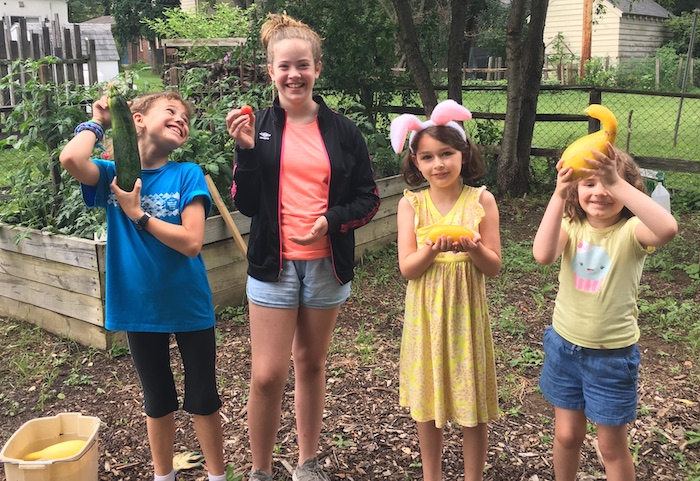
Please note that we plan on starting up our “kid gardening program” as soon as feasible this summer. For last year’s program, see photos on the West Chester Green Team site.
The Victory Garden movement is gaining prominence in the news; see for example an interesting historical perspective in “Food Supply Anxiety Brings Back Victory Gardens” by Tejal Rao in The New York Times, 3/25/20.
For seasonal information on edible wild plants, please see here and links from there. What’s not to like: you just go outside, gather, and eat!
So, once again in the current “war” on the virus: On To Victory!
by Nathaniel Smith, Politics : A View from West Chester, 3/25/20 {Featuring shepherd’s purse, which you can add to your salads right now, and day lilies]
This is a good time to be getting outdoors, not only because of the mostly warming weather, but because it takes our minds off the cares of the world.
This is also a good time to study up on edible wild plants, which offer us free green vegetables without having to go far afield. Do shepherd’s purse, common orange day lilies, dandelion, broadleaf plantain, and ostrich ferns appeal to you? I can vouch for them all.
Wherever you gather plants, be sure herbicides and pesticides have not been used….
Below: shepherd’s purse in water, ready for final cleaning and eating. Read more at Politics : A View from West Chester

Replacing grass with even a few plants native to your region can save insects and the ecosystems that depend on them.
By Tyler Wells Lynch, Yes! magazine, Feb 7, 2020
For years, Toni Genberg assumed a healthy garden was a healthy habitat. That’s how she approached the landscaping around her home in northern Virginia. On trips to the local gardening center, she would privilege aesthetics, buying whatever looked pretty, “which was typically ornamental or invasive plants,” she says. Then, in 2014, Genberg attended a talk by Doug Tallamy, a professor of entomology at the University of Delaware. “I learned I was actually starving our wildlife,” she says.
The problem, Tallamy explained, is with the picky diets of plant-eating insects. Most of these bugs—roughly 90%—eat and reproduce on only certain native plant species, specifically those with whom they share an evolutionary history. Without these carefully tuned adaptations of specific plants, insect populations suffer. And because bugs themselves are a key food source for birds, rodents, amphibians, and other critters, that dependence on natives—and the consequences of not having them—works its way up the food chain. Over time, landscapes that consist mainly of invasive or nonnative plants could become dead zones.

Read more at Yes! magazine
Sierra magazine, 2/3/20
Bader Farms claims Monsanto induces farmers to buy dicamba-tolerant seeds
Update: and farmer won! See “Missouri Farmer Wins $265 Million Verdict Against Monsanto” in Sierra magazine, Feb. 25, 2020.
A showdown is underway in the Midwest as the owner of a large Missouri peach farm seeks to hold the former Monsanto Co. accountable for millions of dollars in damage to his crops—losses the farmer claims resulted from a corporate strategy to induce farmers to buy high-priced specialty seeds and chemicals.
The trial got underway on January 27 in US District Court in Cape Girardeau, Missouri. Farmer Bill Bader, who has grown peaches in Missouri’s “Bootheel” region for 40 years, is seeking more than $20 million. The lawsuit alleges that Bader Farms lost more than 30,000 trees due to Monsanto’s actions, in collaboration with German chemical giant BASF, to profit from a new cropping system involving genetically engineered seeds designed to tolerate dousing of the herbicide dicamba.
Bader claims Monsanto sold GMO dicamba-tolerant soybean and cotton seeds despite knowing the actions would trigger chemical damage to farm fields that were not planted with the new seeds. The intent, the Bader Farms’ lawsuit alleges, was to induce farmers to buy the specialty seeds as a means to prevent crop damage from herbicide drift coming from neighboring farmers who were planting the GMO crops and spraying them with dicamba.
Testing showed that leaves of his dying peach trees carried traces of dicamba. The 5,000-acre family farm, which produced 5 million to 6 million pounds of peaches annually along with corn, soybeans, various berries, apples, and tomatoes, is now struggling to survive, according to Bader.
Monsanto, which was bought by Bayer AG in 2018, and BASF, which initially developed dicamba in the 1950s, have claimed that other factors are to blame for Bader’s problems on his farm, including a soil fungus. The companies deny they have any liability for his losses.
But among the evidence introduced at the Bader Farms trial are internal Monsanto documents showing that the company predicted thousands of drift complaints would occur after its new seed product launch.
Bader is only one of a large and growing group of US farmers who say they are the victims of a clearly foreseen chemical catastrophe many years in the making that has ruined crops covering millions of acres of farmland….
read more at Sierra

Photo by Bacsica/iStockBy Carey Gillam
by Sustainable Pulse Feb 7 2020
Corteva Agriscience will end production of the highly toxic pesticide chlorpyrifos by the end of this year. The company, formerly part of Dow Chemical, has been under increasing scrutiny from environmental and public health advocates for decades and the Natural Resources Defense Council (NRDC) has been in court over the toxic agricultural chemical repeatedly….
read more at Sustainable Pulse

Environmental Health, volume 17, Article number: 23 (2018)
[short version: 93% of the pregnant women in the study had detectable levels of glyphosate, the active ingredient in Roundup, and “these levels correlated significantly with shortened pregnancy lengths.”]
Glyphosate (GLY) is the most heavily used herbicide worldwide but the extent of exposure in human pregnancy remains unknown. Its residues are found in the environment, major crops, and food items that humans, including pregnant women, consume daily. Since GLY exposure in pregnancy may also increase fetal exposure risk, we designed a birth-cohort study to determine exposure frequency, potential exposure pathways, and associations with fetal growth indicators and pregnancy length….
keep reading at Environmental Health
Analysis by Dr. Joseph Mercola, 6/4/19
Keep reading at Dr. Joseph Mercola, and for even worse news:
Tests commissioned by the Environmental Working Group (EWG) revealed the highest glyphosate level — 2,837 ppb — was found in Quaker Oatmeal Squares breakfast cereal,14 a level that makes Impossible Burger’s glyphosate level seem good by comparison — but that’s precisely the sad point….
Tests commissioned by the Environmental Working Group (EWG) revealed the highest glyphosate level — 2,837 ppb — was found in Quaker Oatmeal Squares breakfast cereal,14 a level that makes Impossible Burger’s glyphosate level seem good by comparison — but that’s precisely the sad point.
The following letter was presented to the County Commissioners at their Nov. 19 meeting by Borough Council member Bernie Flynn. For further info including a map of locations in West Chester that are not currently covered by state notification requirements, see here.
Borough of West Chester, 401 East Gay Street ▪ West Chester, Pennsylvania 19380, http://www.west-chester.com, 610-692-7574
| Borough Council Diane LeBold, President; Michael R. Galey, Esq., Vice President; W. Donald Braceland; Bernard J. Flynn; Michael Stefano; Denise Polk, Ph.D.; William J. Scott, Esq. | Mayor Dianne Herrin Borough Manager Michael A. Perrone, C.B.O. |
October 22, 2019
Chester County Commissioners, 313 West Market Street, Suite 6202, West Chester, PA 19380
RE: Notification Process on the Application of Pesticides and Herbicides
Dear Commissioners Kichline, Cozzone, and Farrell,
West Chester Borough Council voted at their September 18, 2019, Council meeting to urge the Chester County Commissioners to require notification to all schools and daycares prior to spraying pesticides and herbicides in the Borough of West Chester. Currently, only public schools are notified. Council believes that all charter, private, independent, and religious schools and daycare centers have a right to be notified prior to spraying pesticides and herbicides within 300 feet of their facility, just as public schools are.
The Borough of West Chester would appreciate your consideration of this request at your next Commissioners’ meeting. Council member Bernie Flynn plans to attend the meeting to follow up with you.
Best regards,
Michael A. Perrone, C.B.O., Borough Manager
C: Borough Council; Robert Kagel, County Administrator
Gail and Les Silberman, activists in Don’t Spray Me! and the West Chester Green Team, are leaving West Chester and moving to Woods Hole, MA. Their environmental colleagues here are so sorry to lose them from our community.
Both Gail and Les have contributed a great deal in a range of areas. Gail’s posts on the Next Door site brought in many new members to the Green Team’s Plastic-Free Please committee. The online responses suggested the depth of support in the community for such an initiative, which passed Borough Council last summer after a turnout of 200 residents advocated for it. Next month, Downingtown Borough Council plans to follow our lead and pass a ban on plastic bags and straws effective July 2, 2020. Even Philadelphia has been influenced by our work on plastics. Thank you, Gail, for your leadership.
We have particularly appreciated Les’ realistic insights into the personalities we work with. His advice on interactions with allies and those resistant to our goals has proven invaluable. His scientific and medical expertise have contributed to many fruitful discussions both through his membership on the Borough’s Sustainability Advisory Committee and on the Board of Don’t Spray Me.!
Both Gail and Les have enriched the community environmentally. They will be greatly missed.
Don’t Spray Me! and the West Chester Green Team offer them our heartfelt best wishes.

 dontsprayme