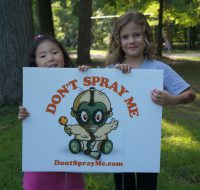
Community activists fight mosquitoes and spraying

by Pete Bannan, Daily Local News, 9/10/16

WEST CHESTER >> Motorists driving through the streets of the borough this summer may have noticed the lawn signs with a baby wearing a gas mask stating ‘Don’t Spray Me.’ Those provocative signs belong to a group of community activists formed to stop Chester County from spraying pesticides in the borough.

Co-founders Margaret Hudgings and Nathaniel Smith recently sat down with a reporter to talk about the group.

“In 2012 the county sprayed in the southwest quadrant of the borough,” said Hudgings. “The morning after it was like silent spring, and we had a lot of people reporting illnesses.”

Three years later, Hudgings and Smith received reports of a plan by the county to spray in the Marshall Square Park area for West Nile mosquitoes which had been discovered in that neighborhood. County Health Department officials planned to use permethrin with permanone, sprayed by truck in the evening after winds had calmed down.

Concerned about the health effects on people and the environment, the two drew up a petition calling for a stop to spraying.

“We assembled a group of five volunteers who walked the southwest quadrant of the borough with a petition asking the county not to spray,” Hedging said. “We got a 98-percent signing rate. People don’t want to be sprayed.”

They presented it to West Chester Mayor Carolyn Comitta and county health officials…

dln-dsm

read more at Daily Local News

The Zika virus and Chester County

by Nathaniel Smith, The Times of Chester County, 9/1/16

Getting rid of standing water is more effective than spraying

News has come around lately that “Pennsylvania Is Now One Of The Top States With Zika Virus ” (Phoenixville Patch, 8/23/16). Currently PA ranks 5th in the number of diagnosed Zika cases. Of course, no one knows how many undiagnosed cases there are anywhere.

Quick quiz: how is Zika spread? If you answered “by mosquitoes,” you’re only half right. It’s our fault too.

It’s important to focus on this note in the article: “All of the cases were travel-related, according to the Centers for Disease Control and Prevention.”

That means no human has acquired Zika from a mosquito in PA. Although the prime mosquito host for Zika, aedes aegypti, does exist in Pennsylvania, it doesn’t do well this far north (yet).

The fact is that Zika is spread not only by mosquitoes but also by people, whether through sexual contact (CDC offers explicit advice on this aspect) or from carrying the virus (usually without symptoms) and being bitten by a mosquito that in turn bites someone else, who thus acquires the disease. The aedes albopictus mosquito, often called “Asian tiger,” has become very numerous in PA but fortunately does not seem to transmit Zika very well (yet).

Spraying pesticides is a limited, short-term fix that leaves many adult mosquitoes alive and does not affect eggs and larvae but harms many forms of life and can lead to acquired immunity. Mosquitoes breed over 500 times faster than people, so they will become immune to whatever we do against them much faster than we can evolve to resist them. Mosquitoes in Puerto Rico and Florida are already becoming resistant to permethrin, the standard anti-mosquito pesticide.

This is all not good news, except that in PA we do have some time to get ready for present and future mosquito-borne diseases….

read more at The Times of Chester County

Mosquito traps made from old tires are 7 times more effective than standard traps

by Melissa Breyer, treehugger, April 8, 2016

A new study found this cheap, easy system significantly reduced virus-carrying Aedes mosquitoes in Guatemala.

Called an ovillanta, a simple mosquito trap fashioned from old tires spells doom for mosquito eggs. So effective is the cheap eco-friendly system that during a 10-month study in Guatemala, the team collected and destroyed over 18,100 Aedes mosquito eggs per month, almost seven times the eggs collected compared to standard traps. Anecdotally, the researchers note that there were no new reports of dengue during the time in the area, normally during that timeframe the community would have reported up to three dozen cases.

The Aedes genus of mosquitoes is primarily responsible for transmitting a host of vexing viruses, including Zika, dengue, chikungunya, and yellow fever. Aedes is notoriously tough to control, according to the World Health Organization. Pesticide-resistance, lack of resources, and a boost in mosquito-friendly environments have hindered traditional methods of controlling the pest’s quick spread.

Created in collaboration by researchers from Canada and Mexico, the ovillanta is made of two 20-inch sections of old car tire secured together in the form of a mouth, with a fluid release valve at the bottom. A milky mosquito-luring non-toxic solution is poured in the bottom – the solution includes a mosquito pheromone that tells female mosquitoes that it’s a safe place to lay eggs. The mosquitoes enter, lay eggs on a paper or wooden strip that is floating in the “pond” … twice a week the little egg raft is removed, the eggs destroyed, and the solution drained and filtered before being reused in the trap again….

ovillanta old tire mosquito trap

read more at treehugger

Aimed at Zika Mosquitoes, Spray Kills Millions of Honeybees

By ALAN BLINDER, New York Times, SEPT. 1, 2016 [n.b. the spraying agency made several “human errors” in this case: spraying a toxic chemical other than as a last resort; not giving adequate public notice, especially to beekeepers; and spraying when bees are active during morning hours and on a hot day. If you ever observe private companies spraying airborne pesticide at times or locations where bees could be active, please document details and let us know.]

The Monday morning scene at Juanita Stanley’s apiary in Summerville, S.C., was ghastly and stunningly quiet: Everywhere one looked were clumps of honeybees, dead after a dousing on Sunday with the potent pesticide with which the local authorities had intended to kill mosquitoes.

“There was no need for a bee suit Monday morning to go down there, because there was no activity. It was silent,” Ms. Stanley said on Thursday. “Honestly, I just fell to the ground. I was crying, and I couldn’t quit crying, and I was throwing up.”

For Ms. Stanley and her business, the death toll easily exceeds two million bees, and Dorchester County officials are still tabulating how many more might have been killed when a day of aerial spraying, scheduled to combat mosquitoes that could be carrying viruses like Zika, went awry. The apparently inadvertent extermination, the county administrator said, happened after a county employee failed to notify Ms. Stanley’s business, which the administrator said should have been alerted about the spraying strategy. Some hobbyists were also caught by surprise.

“We’ve learned that the beekeeping community in Dorchester County, and in that area in particular, is larger than we were aware of,” Jason L. Ward, the county administrator, said in an interview. “Our idea is to balance working with them with the issue of public safety.”

Concerned about the spread of the Zika virus across the South, local officials on Sunday targeted a 15-square mile area of the county, which is near Charleston, with naled. The pesticide, which has been in use in the United States for more than 50 years, is a common tool for mosquito control, but federal officials have said the chemical can be harmful to honeybees while also posing brief risks to aquatic invertebrates and terrestrial wildlife….

read more at New York Times. Also see Melissa Breyer, “Massive bee death after South Carolina sprays for Zika mosquitoes, treehugger, 9/1/16, and “‘Like it’s been nuked’: Millions of bees dead after South Carolina sprays for Zika mosquitoes,” Washington Post, 9/1/16 (see also videos and photos there).

More technical: “NALED Insecticide Fact Sheet” at No Spray Coalition. A dangerous spray, no doubt about it!

Inovio Pharmaceutical’s DNA Vaccine for Zika Virus Induces Robust Immune Responses in Preclinical Study

Inovio Pharmaceutical, 2/17/16

Biotech begins clinical manufacturing; expects to test Zika vaccine in humans in 2016

PLYMOUTH MEETING, Pa., Feb. 17, 2016 (GLOBE NEWSWIRE) — Inovio Pharmaceuticals, Inc. (NASDAQ:INO) announced today that preclinical testing of its synthetic vaccine for the Zika virus induced robust and durable immune responses, demonstrating the potential for a SynCon® vaccine to prevent and treat infections from this harmful pathogen. Health authorities have observed neurological and autoimmune complications potentially associated with Zika virus, including microcephaly in newborns and Guillain-Barre syndrome. Inovio is developing its Zika vaccine with GeneOne Life Sciences (KSE:011000) and academic collaborators.

Read more at Inovio Pharmaceutical. Read about the current clinical trial in Puerto Rico here.

Don’t Spray Me community celebration on Sunday, September 4, at 4-7 p.m. in Everhart Park

Community celebration for Dontsprayme members: Block Captains, displayers of signs, others who support our goals — we’ll ask you to fill out a brief survey and sign in free as members.

What’s happening?

Mayor Carolyn Comitta, who has been indispensable in our successes this year, will speak to us
Friends of Everhart Park
Sierra Club of Chester County
West Chester Food Co-op
West Chester Community Rights Alliance
Info on the Borough’s various green efforts
Games for children; face painting
Bat house construction
Martial arts demo
Meeting lots of local, like-minded people

Union St. side of Everhart Park 

Please bring whatever food and drink you wish to consume (no alcohol), with utensils, plus a blanket or lawn chairs, if desired.

Come celebrate our success in a summer of fewer mosquitoes and no spraying in West Chester!

In case of threatening weather, please check here for any update. Rain date Monday.

History of Dontsprayme to the Sustainability Advisory Council

Margaret Hudgings, on behalf of Dontsprayme, 8/18/16

Don’t Spray Me grew out of citizen concern about spraying in the Borough. The specific issue that rallied support was proposed spraying of Permanone by the Chester County Health Department in Marshall Square Park in late August/early September 2015. More than 300 people signed a petition against spraying and, with the support of Mayor Comitta and Borough Councilman Bill Scott, the Council decided on a “cease and desist” order to stop the spraying.

In October, the West Nile Task Force was formed to work together to reduce mosquitoes and any perceived need for spraying. The three groups involved in the task force are the Chester County Health Department, the Borough of West Chester Public Works Department and the citizen action group Don’tSprayMe. Our goals: reduce mosquitoes and the need for spraying and create a model for other communities to do the same. We would like to assemble a packet of materials that we can hand on to communities with the same mission acting as a model for Chester County and beyond.

Accomplishments to date:

The County and Borough are working together to apply larvicide to storm drains in the borough that have been identified as holding water and being potential breeding grounds for mosquitoes.

The Borough has stepped up enforcement efforts at homes and businesses that have tires stored outside, tall weeds or standing water, especially in trash areas.

The Borough has purchased a vacuum cleaner for storm drains to rid them of debris.

Together we have worked on public education. Continue reading

Comments to the Sustainability Advisory Council, 8/18/16

Nathaniel Smith: views on the role of SAC

I would like to reflect briefly on how the anti-mosquito & non-spray effort fits in to the sustainability theme.

Occasionally people ask us: Aren’t mosquitoes part of the balance of nature too?

Yes, but in an urban environment like West Chester, where the balance of nature is disrupted, they become pests

The stream protection plan, just discussed, fits in nicely here, because natural, healthy streams bring us good drainage and mosquito-eating fish and dragonflies.

If West Chester didn’t have people, we wouldn’t need a Sustainability Advisory Committee. But people are also part of the solution.

The mission statement of this Committee is ”to increase collaboration between Borough departments on issues regarding the economic vitality and environmental sustainability of West Chester Borough.”

And Borough code also says: “The Committee seeks to develop initiatives aimed at increasing Borough staff knowledge, developing community partnerships, and fostering sustainable best management practices.”

In my view, sustainability also extends beyond preserving the balance of nature to assuring that people live in an attractive and healthy natural environment.

The County Health Department is part of the US Environmental Protection Agency’s Pesticide Environmental Stewardship Program, which “promotes the adoption of innovative, alternative pest control practices.” In the EPA’s words, we wish to “work toward pest management practices that reduce the risks to humans and the environment.”

We are asking SAC to also support those goals and to:

– accept the mosquito Task Force as a SAC project

– appoint a SAC member as a regular liaison to the Task Force

– help publicize the Task Force’s outreach to residents