DSM opposes toxic pesticides and herbicides and promotes natural gardening and healthy food. Please like us in Facebook at dontsprayme. Do your part: larvicide stagnant water that you can't dump out!
A New Hampshire activist named Ted Jankowski has been making the case against indiscriminate use of chemicals that can affect both people and the environment.
In an article that someone mistitled “Portsmouth should ban harmful GMOs” (Seacoastonline.com, June 16, 2016), he showed the dangers of Bifenthrin (newly relevant here, as the PA Department of Agriculture is now spreading it around Chester County in a no doubt futile attempt to control spotted lantern fly) and Roundup (which continues its swath of destruction notwithstanding numerous court judgments against its maker Bayer).
And he also showed that the City of Portsmouth was breaking NH state law about advance warning about the use of pesticides and herbicides. It’s hard not to think the same here, as the PA Department of Agriculture is not publicly disclosing where it is spraying Bifenthrin–so how can hypersensitive people (entitled to prior notice of spraying by PA state law) and others avoid exposure?
West Chester Borough residents request free larvicide here. Other municipalities: please do similarly to help cut down on mosquito populations without harming other species.
In May 2019, West Chester Borough officially adopted a well-conceived mosquito abatement plan relying on controlling stagnant water and larviciding where needed. The text can be downloaded here in official form and also is copied below:
Regarding the spread of disease, such as West Nile Virus, through mosquitos, the Borough of West Chester has tasked the Public Works Department to implement the following action plan which replaces all other mosquito/West Nile Virus plans: • The attainment of Larvicide Applicator Certification by at least two Public Works employees. • Continue to store adequate quantity of dunks at its facility to be made available to Borough residents at their request. • Elimination of all sumps from existing inlets inspected and found to facilitate ponding. • Re-double its efforts to keep inlets clean and clear of debris that might inhibit proper drainage. • Establish GIS mapping of current low-lying areas that are deemed susceptible to water ponding. • Identify locations within the Borough that are potential “hot spots” for mosquito breeding for additional investigation by the Public Works Department. • All activities must be consistently coordinated in concert with Chester County Health Department (CCHD) protocol. • Constant communication must be kept with the CCHD as this will further enable the Public Works Department to be pro-active with on-going responses, by their ability to provide more detailed inspection and identification of potential breeding grounds. • Direct residents who observe standing water on properties to call Building, Housing & Code Enforcement at 610-696-1773.
Updated May 9, 2021. Short version: dump standing water; larvicide water that can’t be dumped.
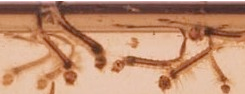
Here is the enemy:
But that photo shows mosquito larvae, which don’t bite.
Right, but once larvae hatch, they are harder to control. One female mosquito, with a protein infusion from blood, lays 100+ eggs. The eggs hatch into larvae, which fly away as adults in a few days. Continue reading →
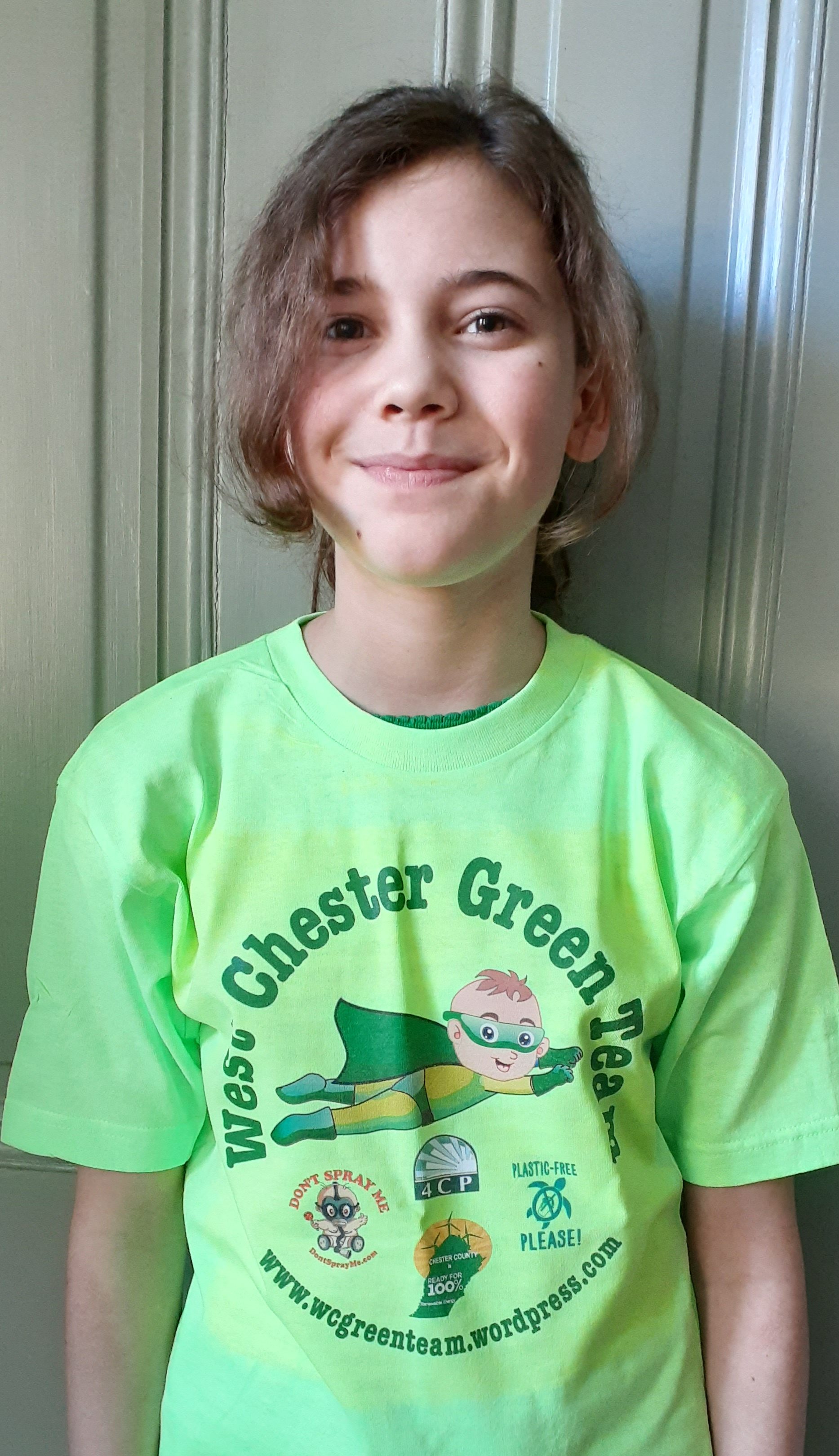
This year Don’t Spray Me! and its associated groups are offering not a new yard sign (see past signs, still available, here) but our first T-shirt. As pictured, you can order it in black or lime green. They are 100% cotton, high quality, made in USA, and will last through many, many washes!
Cost: $15 each with pick-up in West Chester and $20 with delivery by mail or in person. Please email us HERE and specify color, price, and size (small, medium, large, extra large), and we will invoice you accordingly. (N.b.. the small runs small, about 14-16 in youth size; the others are more true to size.)
Pesticides and herbicides applied by air drift, of course. That’s the point. If they just fall to the ground, they won’t kill off what they are designed to kill off.
If you are seeing plants on your property droop inexplicably, investigate immediately and try to determine if a neighboring property has been subjected to any recent application of herbicides. If you suspect drift, contact PennState Extension immediately for advice. They may be able to test the plants quickly and determine the cause. See more here.
Of course, keep an eye out for any potential toxics being applied anywhere near you and politely inform neighbors that if the wind is blowing your way, you will be documenting any damage to your plants.
If anyone in your family has a personal sensitivity to chemicals, they should apply to be on the state’s Registry of Pesticide Hypersensitive Individuals; see info here. This registry does not include herbicides and fungicides, but chances are, if your neighbor is into poisons of one sort, their or their “landscaping” company is applying others.
The registry does not prevent spraying, but it requires that you receive advance notice, so that you can act accordingly.
The manufacturer of one anti-mosquito spray commonly applied by truck says that it kills mosquitoes at 300 feet. Draw your own conclusions about the scope of potential damage from such sprays.
The Chesco Health Department has, in the past, been saying that if they did not spray us, the PA DEP would, whether our county or municipality wanted it or not. In fact, if that happened, it would be the first such case in the state since at least 2000. In December we filed a Right To Know request for DEP to find:
“Records, 2000-2020, of any cases of PA DEP itself spraying for mosquito control A) in counties and municipalities which opposed such spraying, or B) in counties that have their own health departments.”
The answer came back with no such cases of spraying adulticide (that is, spray released from trucks into the air), only 27 cases of PA DEP larviciding in Philadelphia between 2004 and 2016. Don’t Spray Me! supports the use of larvicide, as an environmental way to control mosquitoes before they take wing.
This information may be useful if you hear anyone tell you: “Someone will spray us anyhow, so what does it matter?”
Given the evidence, no community should be sprayed unless they make an informed judgment to accept it.
In 2015 the World Health Organization’s International Agency for Research on Cancer issued a report identifying glyphosate, malathion and diazinon as probable carcinogens and tetrachlorvinphos and parathion as possible carcinogens (Roundup contains glyphosate but also inert ingredients, some of which the manufacturer is allowed to keep secret):
A Working Group of 17 experts from 11 countries met at the International Agency for Research on Cancer (IARC) on 3–10 March 2015 to review the available published scientific evidence and evaluate the carcinogenicity of five organophosphate insecticides and herbicides: diazinon, glyphosate, malathion, parathion, and tetrachlorvinphos. A summary of the evaluations has now been published in The Lancet Oncology. The detailed assessments will be published as Volume 112 of the IARC Monographs….
West NIelds St., 600 block, Feb. 15, 2021. See glove for scale.
And not just one pile, alas!
[Update 24 hours later: kudos to whoever — Public Works, individuals, businesses — shoveled up all that salt, as it now is gone and will not drain into Plum Run after all!]
All this sodium chloride is headed for Plum Run, unless someone shovels it up for future use. And this, ironically, at a time when the Borough is expending a lot of effort to prevent Plum Run’s banks from eroding and is financing rain gardens to reduce runoff and attendant chemicals from entering streams.
The same day, the chloride level in Plum Run at the SW corner of the Borough measured 310ppm.
“In Rhode Island, the Department of Environmental Management (DEM) has set acceptable chloride concentration exposure limits for freshwater organisms at 860 ppm to prevent acute (immediate) exposure effects and at 230 ppm to prevent chronic (long-term) exposure effects. For drinking water, DEM has set a maximum contaminant level of 250 ppm chloride, which is the point at which water starts to taste salty.”
“Chloride is toxic to aquatic life, and even low concentrations can produce harmful effects in freshwater ecosystems. High chloride levels in water can inhibit aquatic species’ growth and reproduction, impact food sources, and disrupt osmoregulation in amphibians. Some 40 percent of urban streams in the U.S. already have chloride levels that exceed the safe guidelines for aquatic life.”
“Runoff containing road salt can also cause oxygen depletion in bodies of water. ‘If runoff containing salt goes into a freshwater lake or stream, it will tend to sink towards the bottom, creating a dense layer that can inhibit gas exchange with the overlying water,’ says Juhl. ‘This can lead to the development of low oxygen conditions that are detrimental to fish and other aquatic organisms.’”
Do you want to measure your own local stream’s chloride content ? See Isaak Walton League: Protect streams from salt! for how to get a free kit. Here’s the measurement from Plum Run (the chloride level is shown by the peak of the yellowish area in the sensor on the right of the photo):
Road salt (sodium chloride) is everywhere during winter months. It keeps us safe on roads and sidewalks, but it can also pose a threat to fish and wildlife as well as human health.
Fish and bugs that live in freshwater streams can’t survive in extra salty water. And many of us (more than 118 million Americans) depend on local streams for drinking water. Water treatment plants are not equipped to filter out the extra salt, so it can end up in your tap water and even corrode your pipes.
You can take action.
Request your FREE Salt Watch test kit….
(Sign up free for a kit to test a stream here. Salt in streams harms not only fish. but also other aquatic life… and humans!)




 dontsprayme
