One in four Americans suffer when exposed to common chemicals

ScienceDaily, March 14, 2018

University of Melbourne research reveals that one in four Americans report chemical sensitivity, with nearly half this group medically diagnosed with Multiple Chemical Sensitivities (MCS), suffering health problems from exposure to common chemical products and pollutants such as insect spray, paint, cleaning supplies, fragrances and petrochemical fumes.

The research was conducted by Anne Steinemann, Professor of Civil Engineering and Chair of Sustainable Cities from the University of Melbourne School of Engineering, and published in the Journal of Occupational and Environmental Medicine. Professor Steinemann is an international expert on environmental pollutants, air quality, and health effects.

Professor Steinemann found the prevalence of chemical sensitivity has increased more than 200 per cent and diagnosed MCS has increased more than 300 per cent among American adults in the past decade. Across America, an estimated 55 million adults have chemical sensitivity or MCS.

“MCS is a serious and potentially disabling disease that is widespread and increasing in the US population,” Professor Steinemann said.

The study used an online survey with a national random sample of 1,137 people, representative of age, gender and region, from a large web-based panel held by Survey Sampling International (SSI).

The study found that, when exposed to problematic sources, people with MCS experience a range of adverse health effects, from migraines and dizziness to breathing difficulties and heart problems. For 76 per cent of people, the severity of effects can be disabling.

“People with MCS are like human canaries. They react earlier and more severely to chemical pollutants, even at low levels,” Professor Steinemann said.

The study also found that 71 per cent of people with MCS are asthmatic, and 86.2 per cent with MCS report health problems from fragranced consumer products, such as air fresheners, scented laundry products, cleaning supplies, fragranced candles, perfume and personal care products.

In addition, an estimated 22 million Americans with MCS have lost work days or a job in the past year due to illness from exposure to fragranced consumer products in the workplace.

To reduce health risks and costs, Professor Steinemann recommends choosing products without any fragrance, and implementing fragrance-free policies in workplaces, health care facilities, schools and other indoor environments.

The “contractual guidelines/agreement with the Pennsylvania Department of Environmental Protection”

That is the phrase used for the first time we can recall in the County release about the spraying of West Chester schedule for this 9/11 evening (unless rain intervenes). For the full document, see “Happy Patriots’ Day, West Chester, from the Chesco Health Department.”

Now we are in possession of the document that must be at the origin of that phrase. Download it here: DEP DH contract for 2018. It’s basically an application to the PA DEP for a maximum of $102,680.40 to aid in anti-mosquito spraying in 2018. (That’s just a portion of the total expense, of course.)

Pages 1-22 are standard bureaucratic stuff. The interesting part comes on pp. 23-25 of the pdf: “2018 Addenda – Scope of Work.” The underlined paragraphs are the actual County submission for the state money.

So the Health Dept wrote its own ticket, telling the State what it wanted to do, the State said OK, and now the County is saying it has to abide by its contract with the state… which it wrote! Circular reasoning, anyone? And still, nothing there says when the County has to spray.

We need to dig deeper, but at this point it is hard to find evidence that the County has lived up to its stated intentions regarding public education, outreach to municipalities, and larviciding. We need to go the Right To Know route, since the information flow to the public has been cut off.

The only positive in the document is that the County commits to 48 hours notice (previously 24). They do not commit to skipping homes of hypersensitive individuals but in the last couple of years they have provided a small buffer around registered hypersensitives and registered apiarists.

Is there another “contractual guidelines/agreement”? We’ll find out.

What is supposed to happen? Has it been happening?

Some questions derived from CDC mosquito control guidelines:

1. Where has the County engaged in source reduction, as recommended?

The only source reduction we know of has been undertaken by West Chester Borough to prevent water from standing in storm drains. Does anyone know of other examples?

2. Where has the County engaged in larval mosquito control, as recommended?

They have told us that they do so, but so far have said they do not have records for 2015-17 and do not have time to tell us where for 2018; our Right to Know request on this with the PA Department of Environmental Protection is pending.

3. Has the County maintained a database of aquatic habitats to identify the sources of vector mosquitoes and a record of larval control measures applied to each (last paragraph below)?

From point 2 above, it would seem doubtful; but the public has a right to know, and we will.

Source material: Centers for Disease Control and Prevention, Division of Vector-Borne Diseases, “West Nile Virus in the United States: Guidelines for Surveillance, Prevention, and Control,” 2016, p. 33. (See the points we have put in boldface below. Download the full publication here).

Integrated Vector Management

Mosquito abatement programs successfully employ integrated pest management (IPM) principles to reduce mosquito abundance, providing important community services to protect quality of life and public health (Rose 2001). Prevention and control of WNV and other zoonotic arboviral diseases is accomplished most effectively through a comprehensive, integrated vector management (IVM) program applying the principles of IPM. IVM is based on an understanding of the underlying biology of the arbovirus transmission system, and utilizes regular monitoring of vector mosquito populations and WNV activity levels to determine if, when, and where interventions are needed to keep mosquito numbers below levels which produce risk of human disease, and to respond appropriately to reduce risk when it exceeds acceptable levels.

Operationally, IVM is anchored by a monitoring program providing data that describe:
• Conditions and habitats that produce vector mosquitoes.
• Abundance of those mosquitoes over the course of a season.
• WNV transmission activity levels expressed as WNV infection rate in mosquito vectors.
• Parameters that influence local mosquito populations and WNV transmission.

These data inform decisions about implementing mosquito control activities appropriate to the situation, such as:
Source reduction through habitat modification.
• Larval mosquito control using the appropriate methods for the habitat.

• Adult mosquito control using pesticides applied from trucks or aircraft when established thresholds have been exceeded.
Community education efforts related to WNV risk levels and intervention activities.

Monitoring also provides quality control for the program, allowing evaluation of:
• Effectiveness of larval control efforts.
• Effectiveness of adult control efforts.
• Causes of control failures (e.g., undetected larval sources, pesticide resistance, equipment failure)….

and p. 34:

Larval Mosquito Surveillance

“Larval surveillance involves identifying and sampling a wide range of aquatic habitats to identify the sources of vector mosquitoes, maintaining a database of these locations, and a record of larval control measures applied to each. This requires trained inspectors to identify larval production sites, collect larval specimens on a regular basis from known larval habitats, and to perform systematic surveillance for new sources. This information is used to determine where and when source reduction or larval control efforts should be implemented….

Happy Patriots’ Day, West Chester, from the Chesco Health Department

[Subsequent note: spraying did occur in West Chester at the scheduled time, but not at WCU, not on S. High St., and because of rain not in the NE part of the Borough.]

Anyone reading this knows that when the County planned to spray West Chester last month, Borough Council unanimously passed a resolution opposing that spraying.

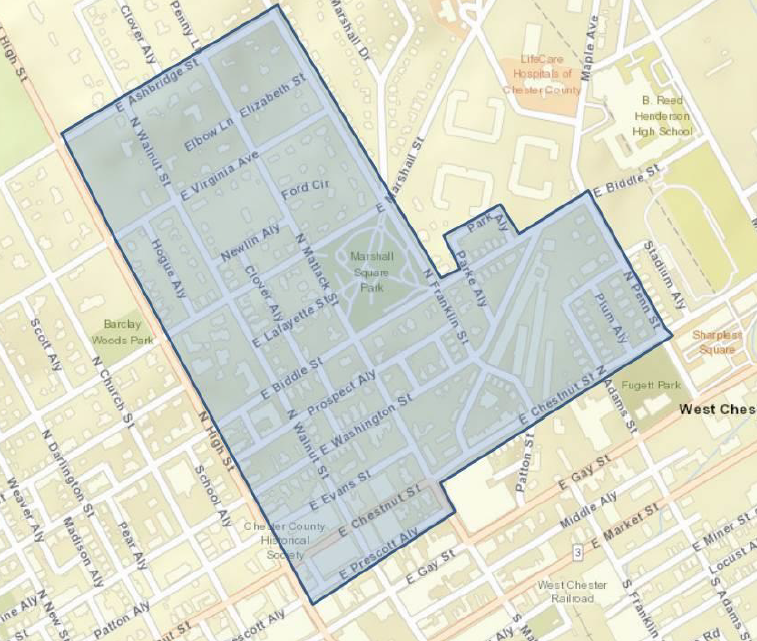
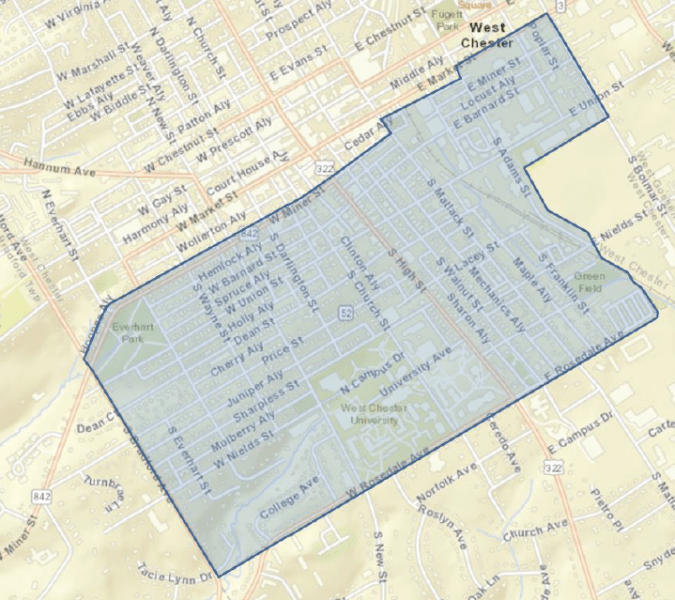
After some verbal and legal back-and-forths, the County has now scheduled spraying again, now for Tuesday evening 9/11, 7:30-11:30 p.m. The affected areas are in the South and Northeast of the Borough (see maps below), impinging on the downtown area where visitors will, as usual, be circulating and enjoying the Borough’s many amenities such as outdoor dining.

This is late in the season to be spraying, and the hot weather on which mosquitoes thrive has now broken (as of Sept. 8), thus presumably reducing mosquito populations soon in any case.

Download the full press release here: 17_2018_WNV_West Chester Spray. See our post “In case of spraying: Help us / Help yourself” here.

We note some interesting changes of wording in the County press release, which begins:

Mosquito control treatment scheduled for West Chester Borough to prevent West Nile Virus

“Following the contractual guidelines/agreement with the Pennsylvania Department of Environmental Protection, the Chester County Health Department will conduct a mosquito control treatment spray in portions of West Chester Borough on Tuesday, September 11th from 7:30 to 11:30 p.m. The rain date for this event is Wednesday, September 12th from 7:30 pm to 11:30pm. The treatment is occurring because of the extremely high level of mosquito samples in areas of the Borough that have tested positive for West Nile Virus. Maps of the area being sprayed are below.

“The Chester County Health Department monitors the presence of mosquitos infected with West Nile Virus and utilizes strategies to prevent and control mosquito larvae. Despite such measures being undertaken in West Chester Borough, numerous mosquito samples have tested positive for West Nile Virus which require mosquito control treatment spray to reduce the risk of transmission. …”

What’s new there from previous wordings (compare to the wording for the release regarding the Sept. 5 spraying of Phoenixville)?

For the first time, the text starts with the phrase “Following the contractual guidelines/agreement with the Pennsylvania Department of Environmental Protection…

This wording is clearly designed to silence the Borough. We have never heard of or seen such a “contractual guidelines/agreement” before. What does, in fact, “contractual guidelines/agreement” mean? Is it a legal contract between the County and the State? Signed by whom and when?

Also note that the expression “which require mosquito control treatment spray” has also crept in. Nothing “requires” spraying; it is a decision made by human beings.

Nothing we have ever heard before suggests that the State obliges the County to spray. We have always understood that the State merely supplies information and guidance but the County makes the decision whether and when to spray. Many counties do not spray and have no mosquito control program at all. No one “requires” them to spray.

And Vector Index levels — to which the public no longer has timely access, since the site that used to have them has not been updated since July 30, and which appear to us scientifically dubious — vary so widely when used to justify spraying that it is clear that spraying is a matter of discretion, not science. Whose discretion? — that is the question.

Now, suddenly we are confronted with a new example of “state preemption,” recalling the claim that municipalities (and presumably the County as well) have no right to put any conditions on the siting, construction, or operation of gas and other pipelines.

In our view, this new example of state preemption runs totally counter to West Chester Borough’s Home Rule Charter as amended with the Community Bill of Rights (section 904) approved by Borough voters in 2015, and notably (A6):

“Right to Clean Air. All residents, natural communities and ecosystems in West Chester Borough possess a fundamental and inalienable right to breathe air untainted by toxins, carcinogens, particulates, and other substances known to cause harm to health.”

Also for the first time, the County press release does not claim to spray only “After exhausting all other available mosquito control strategies….” There we certainly agree: the County has indeed not been “exhausting all other available mosquito control strategies.” In fact, they can’t even tell us where they have larvicided to kill larvae, the chief non-toxic and most effective means of mosquito control.

Instead, the release says: “The Chester County Health Department monitors the presence of mosquitos infected with West Nile Virus and utilizes strategies to prevent and control mosquito larvae.” Of course, we’d like to see more of those strategies. “Kill mosquitos in the water, not in the air!”

The release does not make another change that we have often suggested, in its claim that spraying can “prevent West Nile Virus.” One cannot “prevent” a virus or (in the paragraph just above) “prevent” larvae. One can set out to reduce the number of mosquito or larvae or to reduce the likelihood of disease, but one cannot “prevent” them.

As usual, the release uses euphemisms like “treatment” and avoids the terms “insecticide” and (until the boilerplate language at the end of the release about the Pesticide Environmental Stewardship Program ) “pesticide.”

These are not semantic quibbles. Like the scientific and procedural claims that often come from the pesticide industry itself and that we have often criticized, these choices of words tend to mislead the public and office-holders into thinking that spraying is a helpful and healthful “treatment.”

See maps of planned spray areas below. These are the same as planned last month, as it happens. We can’t compare to any evolution in “Vector Index” scores, because those are not longer available to the public. To line up the maps (which are on different scales), look for High St. running N and S (tilting some to the left) in both maps or for Fugett Park, the spot of green below the top map and above the bottom map. In the downtown area, Gay St. and much of Market are not on the direct spray route, but the 200 block of E. Market is. And, naturally, spray drifts; if it didn’t drift, it would stay on the streets where the spray truck passes, and the whole point of the exercise is to spread the pesticide around in people’s yards.

NE West Chester:

Southern West Chester:
DeltaGard, deltamethrin

In the past, Chester County has sprayed pyrethrin in an effort to attack mosquitoes. No chemical pesticide is selective; a poison that kills adult mosquitoes will inevitably affect other forms of life. (Biological agents such as larvicides are much more selective.)

Now the County seems to have gone over to another member of the pyrethroid chemical group, DeltaGard, whose active ingredient is deltamethrin.

The information below is mainly about the DeltaGard variant for use in gardens and landscaping, which has the same active ingredient as the DeltaGard insecticide used against mosquitoes. For more on the mosquito spray, see here.

What’s deltamethrin? Of course, the industry doesn’t think it’s dangerous. Some other sources beg to differ. A relatively recent post in Chemicals.News (no friend to the chemical industry) says:

“Deltamethrin — toxicity, side effects, diseases and environmental impacts”

12/05/2017 / By Rita Winters

Deltamethrin is a pyrethroid insecticide that is registered for use in commercial, agricultural, and residential areas. It plays a role in controlling malaria and targets other insects like cockroaches, spiders, ants, fleas, silverfish, bed bugs, bird mites, house flies, and beetles. Deltamethrin products are one of the most popular and widely used pesticides in the world and are very popular with government pest control operations in the country. It is highly toxic to the environment, especially to aquatic life forms like fish and crustaceans. Deltamethrin is also known to be toxic to humans. As a neurotoxin, it attacks the nervous system and causes a variety of negative side effects and fatality. In 2011, a Japanese woman ingested large doses of pesticides that contained deltamethrin, which resulted in motor neuron death.

This chemical compound acts by blocking the closure of the ion gates of sodium channels during repolarization. It then disrupts the transmission of nerve-related impulses causing depolarization of the nerve cell membranes. It is very effective on insects, especially those considered as pests. However, it also affects beneficial insects including honey bees….

read more at Chemicals.News

According to the National Pesticide Information Center: “While children may be especially sensitive to pesticides compared to adults, it is currently unknown whether children have increased sensitivity specifically to deltamethrin….” (Parents will not wish to experiment to find out.)

Also: “When deltamethrin gets in the soil, it has a tendency to bind tightly to soil particles. It has a half-life ranging from 5.7- 209 days. Half-life is the measure of time it takes for half of the applied amount to break down…. Deltamethrin has a half-life of 5.9-17 days on plant surfaces. It is unlikely to be taken up by plants, since it binds to soil particles so tightly….” (So that could be reassuring if you are out for a walk in the street, but not so much if you’d like to consume your own organic produce or turn over your garden knowing that may have pesticide residue in it for up to 7 months.)

“NPIC provides objective, science-based information about pesticides and pesticide-related topics to enable people to make informed decisions. NPIC is a cooperative agreement between Oregon State University and the U.S. Environmental Protection Agency.” Download the pdf of its deltamethrin report here: Deltamethrin General Fact Sheet

See some other sources at these sites:

https://www.ncbi.nlm.nih.gov/m/pubmed/28551743/
https://www.ncbi.nlm.nih.gov/m/pubmed/22079160/
https://www.ncbi.nlm.nih.gov/pmc/articles/PMC4502505/
https://www.ncbi.nlm.nih.gov/pmc/articles/PMC1257607/#!po=76.0417
https://www.ncbi.nlm.nih.gov/m/pubmed/29444244/

Deltamethrin molecule
The manufacturer’s label (download here: deltagard-5sc-label ornamental) contains an immense list of insects as well as spiders that DeltaGard kills when used on lawns and landscaping. The list includes ants, caterpillars, crickets and grasshoppers, among others that most of us might not see as pests but as important members of the environment; and many of the target species are important food sources for birds, amphibians, and reptiles.

And that is just for the supposed pests. Of course they don’t list the other species than can be killed, such as adult butterflies and dragonflies.

And the label says, not reassuringly for those of us with home gardens:

“DO NOT apply this product to edible crops.”

If you want further non-reassurance, download the manufacturer’s Safety Data Sheet relevant to mosquito spraying here: DeltaGard_Insecticide, including statements such as:

“This product contains material which are Trade Secret and may have Occupational Exposure Limits.”

“Do not allow to get into surface water, drains and ground water.”

Tell the National School Boards Association: No More Monsanto Roundup Weedkiller!

Petition from MoveOn

To be delivered to Frank C. Pugh, President, National School Boards Association, All National School Boards Association Board Members

As the organization representing the top decision-makers at U.S. school districts, you have a responsibility to millions of parents and school children to protect children from harm.

In light of the latest evidence that Monsanto’s Roundup weedkiller causes cancer, the National School Board Association must do these two things:

One, issue a formal policy statement advising all school districts to end the use of Roundup and all toxic agro-chemicals on school grounds.

Two, issue a formal policy statement advising all school districts to revamp their school lunch programs by transitioning to certified organic foods, in order to avoid serving foods contaminated with glyphosate and other pesticides.

On August 10, 2018, a jury awarded $289.2 million to Dewayne “Lee” Johnson, a former school groundskeeper whose job required him to spray Monsanto’s Roundup weedkiller on school properties.

Mr. Johnson is terminally ill with non-Hodgkin lymphoma, a type of cancer linked to the use of Monsanto’s Roundup and other glyphosate-based weedkillers.

In the case of Dewayne Johnson v. Monsanto Co, Johnson’s lawyers argued that Monsanto’s flagship weedkiller caused Mr. Johnson’s cancer. They also presented evidence that Monsanto had known for decades that Roundup could cause cancer, but that company officials intentionally failed to warn consumers about that risk.

In March 2015, the World Health Organization’s International Agency on Cancer Research classified glyphosate, the active ingredient in Roundup, as a “probable” human carcinogen.

On August 15, five days after the verdict in Dewayne Johnson v. Monsanto Co., California’s Supreme Court rejected Monsanto’s challenge to the state’s decision to list glyphosate as a potential carcinogen under the California’s Proposition 65, a law requiring the state to publish a list of chemicals known to cause cancer or birth defects.

In the U.S., more than 26 million pounds of Roundup are sprayed every year on school grounds, public playgrounds and gardens.

Recent testing reveals that glyphosate is present in a multitude of common conventionally grown foods, including those served in school cafeterias.

Toxic poisons have no place in U.S. schools, either on playgrounds or in cafeteria food. Please act immediately to rid schools of Roundup and other toxic chemicals.

Phoenixville and Schuylkill the next to be sprayed

Chester County press release:

West Chester, PA – The Chester County Health Department will conduct a mosquito control treatment spray in portions of Phoenixville Borough and Schuylkill Township (see maps below). The treatment is scheduled for Wednesday, September 5th from 7:30 pm to 11:00 pm. The rain date for this event is Thursday, September 6th from 7:30 pm to 11:00 pm….

Read the full release at the above site.

This planned spraying with the pesticide deltamethrin involves big chunks (see maps online) of densely populated neighborhoods. (Isn’t it odd how the press release text finds euphemisms so as not to use the term “pesticide,” which occurs only in the EPA-related statement at the very end?)

As mentioned in “Mosquito spraying and public information,” the public and their elected representatives can’t find the underlying data online because the usual sites have not been updated recently. “Just trust us”?

On the futility of this kind of spraying, see “Why don’t they just spray and kill all the mosquitoes?

If you are in one of the spray areas, please see “In case of spraying: Help us / Help yourself.” You should protect yourself and y our family, but also your observations can help us catalogue the conditions and effects of spraying.

Voter Bayer… for Corporate Hall of Shame

Corporate Accountability International is asking people to vote for the “Corporate Hall of Shame.”

Our first choice: pesticide industry giant Bayer, about to merge with agrochemical giant Monsanto.

Bayer is a top manufacturer of neonicotinoid pesticides, which are a key factor in beekeepers losing nearly 50% of their hives this year.

Bayer also happens to manufacture both Permanone and DeltaGard, the 2 anti-mosquito pesticides sprayed recently by the Chester County Department of Health.

You can vote for 3 “candidates” here. There are plenty of other worthy choices for the honor as well.

Please join us Fri. Aug. 31!

Friday Aug. 31, 11:30am to 1pm, rain or shine.

Show our views about pesticide spraying at the weekly Concerned Constituent Action Group rally.

Location: NW Corner of High Street and Market Street, at the Historic Chester County Courthouse, West Chester.

Bring a poster or DSM sign, or pick up one there.

On-street parking or park at the Bicentennial Parking Garage at 20 S. High Street, West Chester.