New Study Shows Roundup Kills Bees

Sierra, 10/3/18

Glyphosate targets undesired weeds—as well as honeybees

The most widely sprayed herbicide in the world kills honeybees, according to a new report.

Glyphosate, an herbicide and active ingredient in Monsanto’s (now Bayer’s) Roundup weed killer, targets enzymes long assumed to be found only in plants. The product is advertised as being innocuous to wildlife. But some bacteria also use this enzyme, including a microbiome found in the intestines of most bees. When pollinators come in contact with glyphosate, the chemical reduces this gut bacteria, leaving bees vulnerable to pathogens and premature death.

“The bee itself has no molecular targets from glyphosate,” Nancy Moran, a biologist at the University of Texas at Austin and a coauthor of the study, told Environmental Health News. “But its gut bacteria do have targets.”

Moran and other scientists liken glyphosate exposure to taking too many antibiotics—and upsetting the balance of good bacteria that supports immunity and digestion….

read more at Sierra

Sierra Club Youth Corps, summary 2017-

The Sierra Club Youth Corps is a summer program offered by Don’t Spray Me! beginning in 2017.

As part of the Sustainability Committee of Sierra Club’s Southeastern PA Group, Don’t Spray Me! works toward Sierra Club’s goal of cutting back human practices harmful to nature and human health.

In SCYC’s 2017 project, organized by Margaret and Jim Hudgings, a group of high school students (photo below by Bill Rettew, Daily Local News, 7/17/17) experimented on neighborhood sidewalks to show that a non-toxic solution is effective in fighting weeds in brick sidewalks.
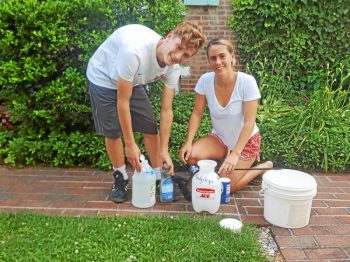
This anti-Roundup weed-killing formula consists of:

1 gallon distilled white vinegar
1/2 cup table salt
1/2 teaspoon liquid dish soap

How to do it: Pour a small amount of vinegar into your, then pour the salt into the jug of vinegar and shake it vigorously. Pour the salted vinegar into the sprayer and add the liquid dish soap. Swirl the sprayer to mix in the soap, but not so much as to generate suds. Spray it on the target weeds, ideally in the morning of a very sunny day. When finished, spray plain water for a few seconds to clean the wand.

SCYC’s 2018 project, Adopt A Drain, was organized by geologist Rachel Davis. Thanks to a generous Sierra Club Grassroots Network grant, we were able to hire West Chester University graduate student Kyle Erisman to be part of the field surveys and particularly to produce GIS mapping of storm drains in the Borough.
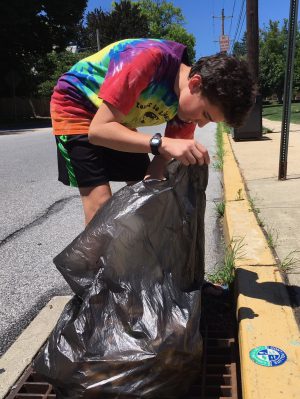
Participants, under careful guidelines, walked selected streets to locate storm drains, clear above-ground blockage (including environmentally damaging plastic bags), peered through the street grills, and reported to the Borough Department of Public Works whether drains needed attention as being clogged below ground or containing potentially mosquito-breeding stagnant water (below: map by Kyle Erisman showing drains, streams, and other features).

In 2019, we plan to continue this project by organizing citizens to patrol storm drains in their neighborhoods and report drainage problems to the Borough, while reorienting the Sierra Club Youth Corps to another innovative and educational project.

Tell the USDA: Test our food for Monsanto’s toxic glyphosate NOW

from Friends of the Earth, 10/4/18

The USDA tests our food for pesticides to make sure it’s safe for us to eat. But it’s not testing for glyphosate — a.k.a. Monsanto’s Roundup®.

The California Supreme Court recently affirmed that glyphosate is dangerous to humans. The World Health Organization named it as a probable carcinogen. And the EU and Canada are already testing for it in food.

The USDA is dragging its feet on protecting us from this toxic pesticide. We need your help to change that!

Tell the USDA: Test our food for Monsanto’s toxic glyphosate.

The science is clear. Roundup® is terrible for people and the planet. It’s used to douse our food, including common crops like soy and wheat. This toxic pesticide is ending up on our plates and in our bodies.

The amount of Roundup® being used each year has increased significantly. Use jumped from only 11 million pounds in 1987 to nearly 300 million pounds in 2016.

That means Roundup® is sneaking into our food in increasingly dangerous ways. This summer, new tests revealed glyphosate in cereal and granola bars commonly eaten by kids….

read more details and sign here.

What’s the big public health crisis here? (update)

Number of deaths in Chester County, 2015-18 to date:

from West Nile Virus: 0.

from flu (data for those years from PA Department of Health and Philly Voice): 34 (extrapolating from 221 + 64 + 149 + 156 + 256 in PA X 520,000 approx. County population / 12,825,000 approx. PA population) (more than 80,000 Americans died from flu in the 2017-18 season; flu deaths tend to start in October)

from homicides and suicides: 7 + 52 = 59, per Chesco Coroner

from drug overdoses according to OverdoseFreePA: 415. (In the US: more than 72,000 deaths in 2017.)

Opioid deaths in Chesco and PA are rising dramatically while WNV deaths have averaged under 2 a year in the entire state, according to CDC (one so far in 2018).

Could the Health Department use its mosquito control funding more beneficially to reduce actual causes of death in the County?

Could the Chesco Department of Drug and Alcohol Services, which deals with opioid issues, put to good use the public resources that the Health Department is using to track and spray for mosquitoes?

The latest drug scourge, the herbal supplement kratom, has killed two Chesco residents this year, in April and June. Searching the County web site turns up only a 8/20/18 press release from the Coroner’s Office (which provoked attention in the media) and a couple of presentations for professionals.

Why does the County give little public attention to a drug that has killed 2 this year, compared to a flurry of spraying and press releases concerning West Nile Virus, which has killed just one person in Chester County in 2001-18? (And that one fatal WNV infection since WNV was first recorded here, in an elderly man, was acquired out of state.)

Is the County allocating taxpayers’ resources in the optimal way to support human health, safety, and well-being?

Not to mention warning Chester County residents about the dangers of pesticides and herbicides….

Pesticides Putting Pajaro Valley Schools at Risk, Teachers Say

By Georgia Johnson, Good Times, 9/25/18

Fear flourishes amid industry reassurance, conflicting data

When third-grade teacher Melissa Dennis started working at Ohlone Elementary in Watsonville, she pictured her students playing in the adjacent strawberry fields, picking berries and running through rows of strawberries. But the more she talked to other teachers, the more she realized the reality might not be so idyllic.

“I started hearing about teachers in the past who had been organizing against pesticide use,” Dennis said. “I started thinking maybe I should be careful about drinking the water. But I never thought about the air.”

Ohlone Elementary was built right in the middle of farmlands. No one seems to knows why this location was chosen; the fact that surrounding farms use hundreds of gallons of pesticides and fumigants annually would make it seem less than ideal. Scientific findings on the dangers of pesticide exposure are complicated and sometimes confusing, but for residents, teachers, and farmworkers, the proof is in their experience and stories.

“When you read the label on the products, it says ‘these pesticides are toxic for small mammals, insects, frogs, birds,’” Dennis says. “They use thousands of pounds of this stuff all around us. What are human children but small mammals?”

Dennis eventually joined Safe Ag Safe Schools (SASS), a Salinas-based subgroup of Californians for Pesticide Reform (CPR), with a few other Pajaro Valley Unified teachers who say they have witnessed multiple cases of brain tumors, neurological problems and severe respiratory illness in young children at their schools. Just yards away from many of these schools, tarps stretch across pesticide-treated fields and teachers keep the windows of their classrooms shut….

read more at Good Times

Who says storm drains are a big mosquito problem?

The PA Department of Environmental Protection, that’s who!

We usually call them “storm drains” but others use the term “catch basins” or “inlets.” In any case, that’s where runoff from streets goes through a grill and disappears from our sight. But then were does it go? It should drain by gravity though a pipe system and eventually flow into a stream. That’s a problem for the stream, because street runoff can be polluted, e.g, by car and animal wastes.

But when water is able to remain standing in the storm drain, it provides an ideal habitat for mosquitoes to breed! Then those storm drains need to be “treated” (with a larvicide like Bti) to keep larvae from maturing there into adult mosquitoes. Here’s what PA DEP says (you have to keep refreshing the URL in your browser to find this photo and commentary):

One man’s suffering exposed Monsanto’s secrets to the world

by Carey Gillam, The Guardian, 8/11/18

It was a verdict heard around the world. In a stunning blow to one of the world’s largest seed and chemical companies, jurors in San Francisco have told Monsanto it must pay $289m in damages to a man dying of cancer which he claims was caused by exposure to its herbicides.

Monsanto, which became a unit of Bayer AG in June, has spent decades convincing consumers, farmers, politicians and regulators to ignore mounting evidence linking its glyphosate-based herbicides to cancer and other health problems. The company has employed a range of tactics – some drawn from the same playbook used by the tobacco industry in defending the safety of cigarettes – to suppress and manipulate scientific literature, harass journalists and scientists who did not parrot the company’s propaganda, and arm-twist and collude with regulators. Indeed, one of Monsanto’s lead defense attorneys in the San Francisco case was George Lombardi, whose resumé boasts of his work defending big tobacco.

Now, in this one case, through the suffering of one man, Monsanto’s secretive strategies have been laid bare for the world to see. Monsanto was undone by the words of its own scientists, the damning truth illuminated through the company’s emails, internal strategy reports and other communications.

The jury’s verdict found not only that Monsanto’s Roundup and related glyphosate-based brands presented a substantial danger to people using them, but that there was “clear and convincing evidence” that Monsanto’s officials acted with “malice or oppression” in failing to adequately warn of the risks….

read more at The Guardian